


Creative tactics that change how people see brands, products, behaviours and problems
Perception decides what people notice, trust, ignore, pay for, share and defend.
A product can be useful and still feel dull.
A behaviour can be sensible and still feel embarrassing.
A category can be full of good products and still feel invisible.
A cause can be urgent and still feel too abstract to act on.
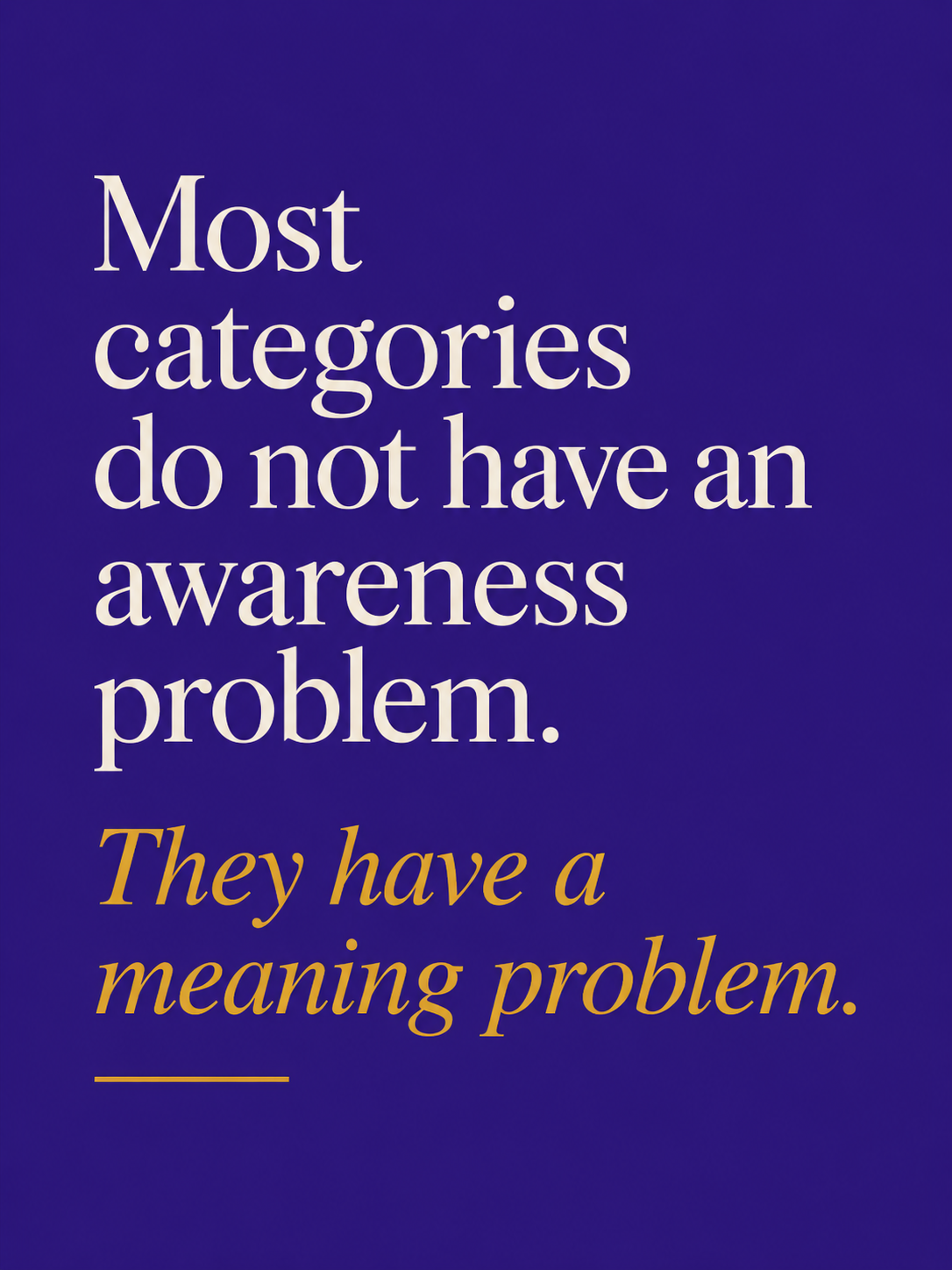
Shift Perception is about changing how audiences categorise, emotionally interpret and culturally value brands, products, behaviours and problems.
The Shift Perception Engine is the downloadable pack built to help your AI do that work. It gives your AI the questions, frameworks, sub-tactics, reframes and verified campaign examples needed to challenge assumptions, expose hidden truths, pick sharper enemies, disrupt category norms and turn familiar ideas into more provocative starting points.
A hostel becomes glamorous.
A flaw becomes evidence of confidence.
A cheap product becomes desirable.
An ignored issue becomes morally difficult to avoid.
A category convention becomes ridiculous once someone stages it properly.
Shift Perception tactics are designed to make the old interpretation stop working.
Why Perception Matters
People do not judge brands from a neutral starting point.
They use shortcuts:
- what category this belongs to
- who this is for
- whether people like me use it
- whether it feels premium, cheap, risky, embarrassing or normal
- whether the problem feels urgent enough to deserve attention
Those shortcuts shape value before the product is even experienced. Change the shortcut, and you change the judgment. That is why perception affects pricing power, memorability, trust, relevance and action. The work is not just about making people notice. It is changing what people think they are noticing.
When To Use Shift Perception Tactics
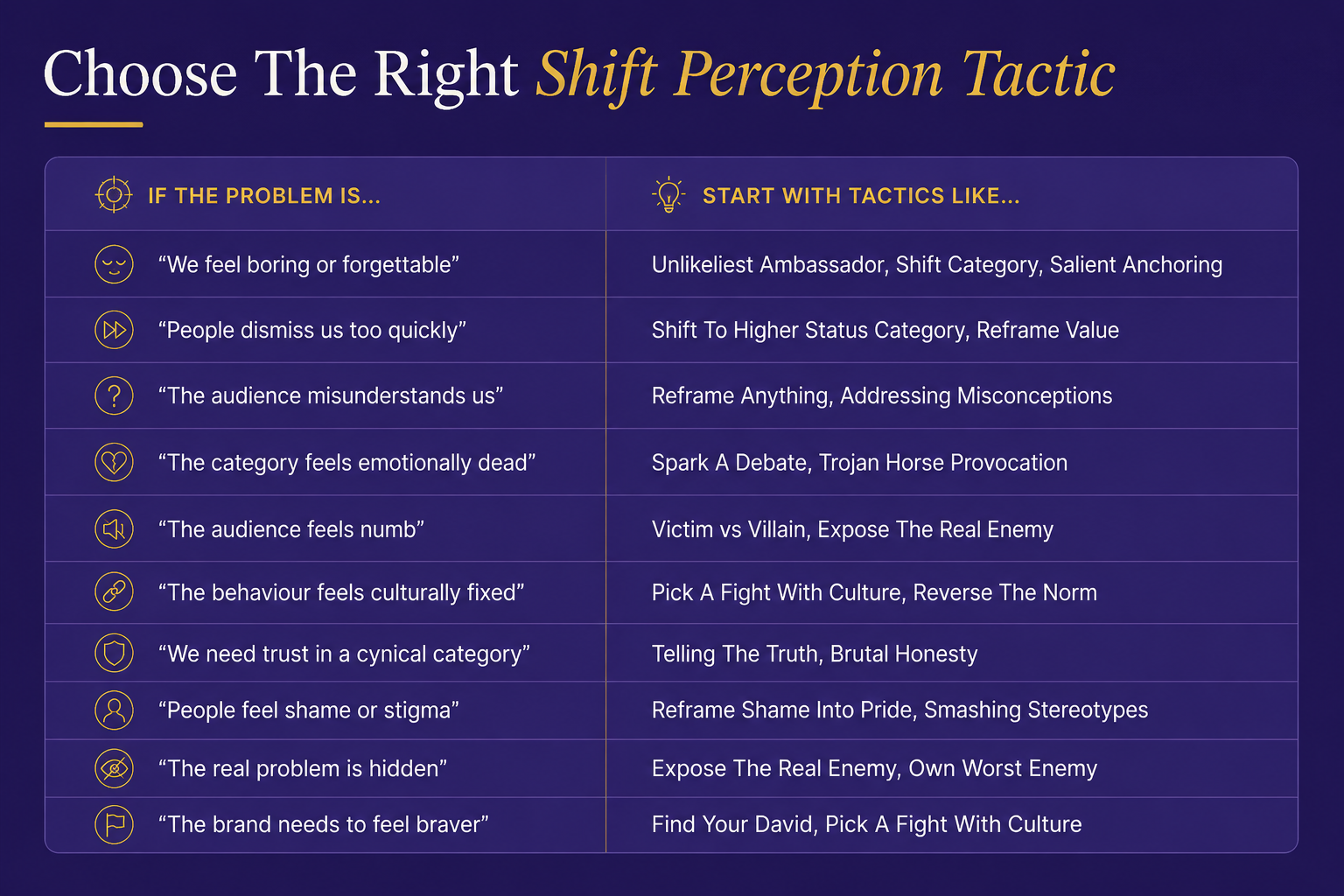
Use these tactics when:
- your category feels boring or invisible
- audiences dismiss you too quickly
- your product carries stigma or low status
- people misunderstand what you actually do
- competitors own the default mental framing
- behaviour feels culturally fixed
- audiences have become emotionally numb
- your problem feels abstract or distant
- people intellectually agree, but do not care enough to act
- the category has conventions everyone keeps sticking to
These are briefs where another benefit line will not fix the problem. The frame needs to move.
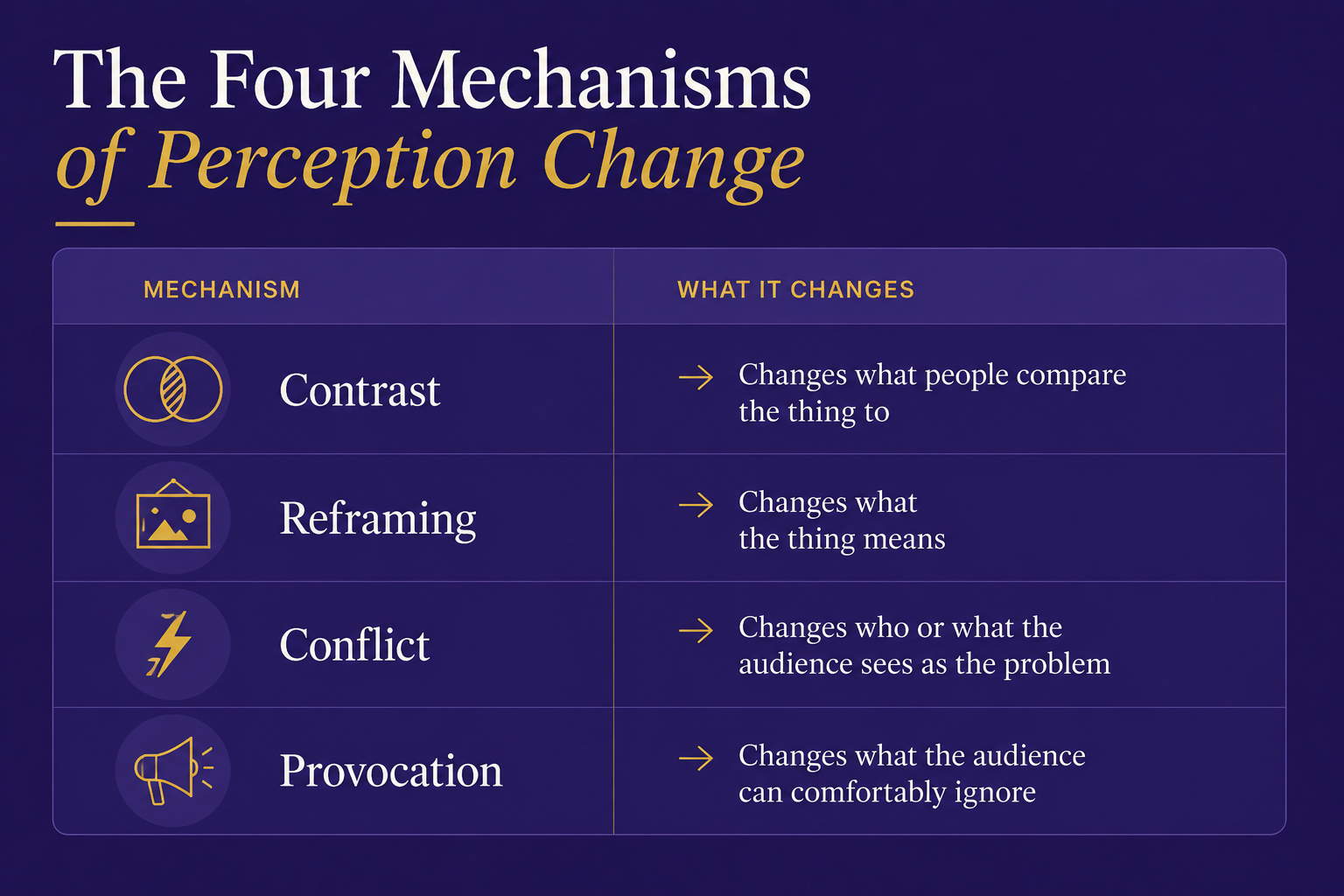
The tactics below sit inside those four mechanisms:
1. Shift Perception Through Contrast
Contrast tactics put something in the wrong role, category or context. The mismatch creates surprise. The surprise creates reappraisal. Use this when a product, brand or issue is trapped by familiar assumptions.
Unlikeliest Ambassador

Unlikeliest Ambassador makes boring, overlooked or hard-to-reframe products feel culturally interesting by pairing them with somebody who feels wrong for the category.
The pairing does the work. Mariah Carey in a hostel. Snoop Dogg going smokeless. Porn actors explaining online safety to parents.
The audience has to reconcile two things that should not belong together. That moment of “hang on…” creates talkability and reappraisal.
Best used when
- the category feels dull
- the audience has stopped noticing
- the product needs cultural energy quickly
Related tactics
Shift Category · Salient Anchoring · Trojan Horse Seduction · Spark A Debate
Shift To Higher Status Category

Shift To A Higher Status Category relocates an ordinary product into a more prestigious cultural world. Fashion. Art. Fine dining. Elite sport. Space travel. Luxury retail. The product borrows new evaluation criteria.
Best used when
- the product feels too functional
- the category lacks aspiration
- quality is underestimated
Related tactics
Unlikeliest Ambassador · Salient Anchoring · Shift Category
2. Shift Perception Through Reframing
Reframing tactics change what something means. They recode the emotional or cultural interpretation attached to a product, behaviour, category or identity.
A stigmatised behaviour becomes a badge of pride.
A stereotype becomes outdated.
A category rule becomes absurd.
Reframe Anything
Reframe Anything is the operating system for finding the stuck part of a brief.
Sometimes the problem is identity.
Sometimes it is category logic.
Sometimes it is value.
Sometimes it is meaning.
The guide helps identify which frame is holding the brand back, then changes the lens through which audiences judge it.
Best used when
- the audience understands but does not care
- the category feels stuck
- the brand needs a new interpretation
Related tactics
Shift Category · Smashing Stereotypes · Telling The Truth
Smashing Stereotypes
Smashing Stereotypes challenges assumptions culture keeps repeating until they feel natural. The tactic replaces lazy defaults with more truthful and emotionally resonant representations.
Best used when
- audiences feel misrepresented
- culture has moved faster than the advertising
- the category relies on outdated assumptions
Related tactics
Pick A Fight With Culture · Reframe Identity · Addressing Misconceptions
3. Shift Perception Through Conflict
Conflict tactics clarify meaning by introducing opposition. The enemy might be:
- a system
- a cultural habit
- a hidden incentive
- a social norm
- the audience’s own behaviour
Conflict gives the audience something to orient around.
Find Your David
Find Your David makes a challenger, cause or brand feel brave by placing a smaller symbolic figure directly against a larger force. The power comes from imbalance.
Best used when
- the issue needs a symbol
- the campaign needs visual clarity
- bravery matters more than dominance
Related tactics
Victim vs Villain · Pick A Fight With Culture · Expose The Real Enemy
Expose The Real Enemy
Expose The Real Enemy reveals who benefits when the problem continues.
The tactic names the hidden incentive:
- the company profiting from harm
- the institution benefiting from delay
- the system relying on confusion
Best used when
- blame is misdirected
- the audience misunderstands the root problem
- the campaign needs moral clarity
Related tactics
Victim vs Villain · Telling The Truth · Own Worst Enemy
4. Shift Perception Through Provocation
Provocation tactics create friction deliberately. They interrupt rituals, bait argument, hijack formats or stage discomfort in public. These tactics work when polite explanation has become too easy to ignore.
Pick A Fight With Culture
Pick A Fight With Culture targets a dominant behaviour, ritual, trend or aesthetic and exposes what it hides. The campaign uses culture’s own language against it.
Best used when
- a cultural habit has become empty or harmful
- the audience recognises the behaviour
- the norm needs to be made visible
Related tactics
Spark A Debate · Trojan Horse Provocation · Smashing Stereotypes
Spark A Debate
Spark A Debate creates purposeful friction by giving people something to argue about. The tactic turns passive reach into public participation.
Best used when
- the category lacks emotional intensity
- social sharing matters
- the audience enjoys taking sides
Related tactics
Pick A Fight With Culture · Trojan Horse Provocation · Telling The Truth
How The Shift Perception Engine Works
- Upload the guides to your AI
- Give it a brand, audience and problem
- Choose a perception shift tactic
- Explore the reframes, tensions and prompts it surfaces
- Decide which direction deserves pushing further
What is a Thinking Engine?
A thinking engine is a curated pack of downloadable guides sourced from a growing database of over 14,000 campaigns. Upload a pack to your AI, and it gains the questions, frameworks, sub-tactics, reframes and verified campaign examples to think with directed divergence on your next brief.
Everything on this site was written using an engine.
So if you like what you see, your AI can think like everything on here and apply it to your next brief before your next coffee goes cold.
The Shift Perception Engine
This engine gives your AI a set of heavyweight guides for reframing problems, challenging assumptions, exposing hidden truths, picking sharper enemies, disrupting category norms and turning familiar ideas into more provocative starting points.
Tactics included:
- Address Misconceptions
- Dumb Thinking
- Pick An Enemy
- Reframe Anything Playbook
- Salient Anchoring
- Shift Category
- Smash Stereotypes
- Spark A Debate
- Tell The Truth Playbook
- Trojan Horse Seduction
- Trojan Horse Provocation