

Value is rarely contained in the number. It comes from what the number is compared with, measured against, expected to deliver or understood to prevent.
The strategist's job isn't always to lower the price. It's to change the frame around it so the audience judges the offer differently. Here are nine creative reframe tactics that make value land in more interesting ways.
- Earned Value
- Comparative Value
- Smart Alternative Value
- Dignified Value
- Exposed Value
- Amplified Value
- Change the Measure
- Investment Value
- Consequence Value
1. Earned Value
Make the thing that looks like a problem do the selling for you.
Time is Money — IKEA Dubai, Memac Ogilvy, 2016
IKEA Dubai had a reach problem: the store was genuinely far away, and customers resented the journey. Rather than apologise for the distance, IKEA used Google Maps data to convert travel time directly into store credit — the longer your journey, the bigger your discount. The drive stopped being wasted time and became something you could spend. The barrier became the currency.
Renault's Cars to Work (Publicis, 2023) let jobseekers access cars before paying for them, anchoring the cost to future income and reframing ownership as an investment in getting employed rather than a financial stretch. Ford's That Affordable (BBDO Saudi, 2023) compared SUV ownership to what Saudi drivers already spend monthly on food delivery apps, making a major purchase feel like a simple trade. The mechanism in all three is the same: the audience's barrier becomes the proof that the value is real.
2. Comparative Value
Make the price feel different by changing what people compare it to.
Tickets v Tickets — Air Transat, Courage, 2026
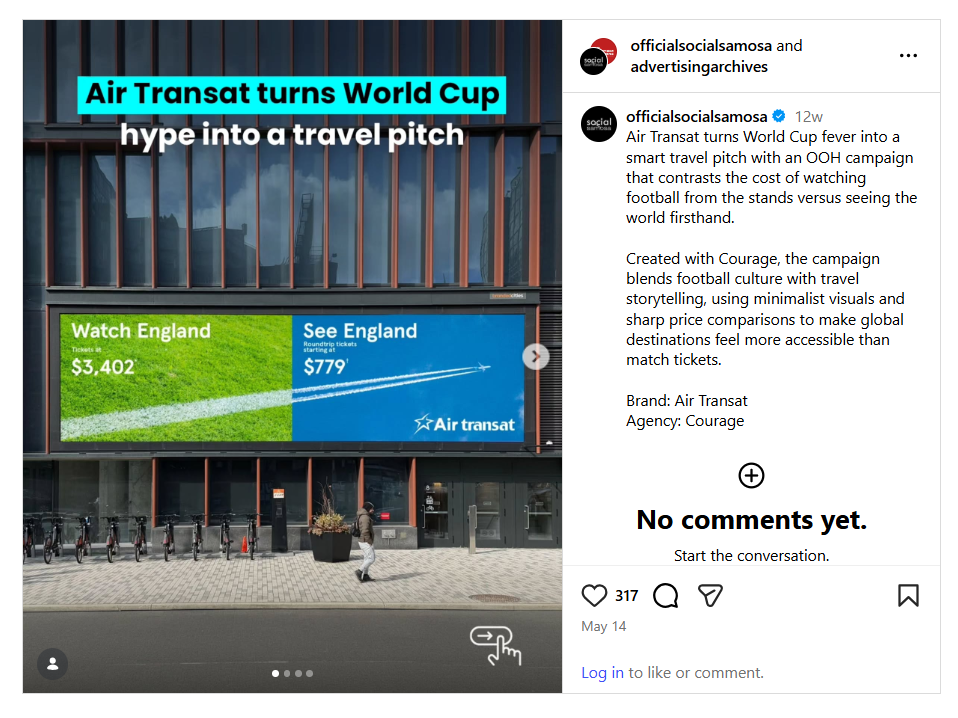
Football ticket prices had become a source of frustration. Air Transat changed the comparison. Instead of asking people to compare one match ticket with another, the campaign compared real match prices with flights to the countries fans were supporting. For roughly the cost of watching the match from a stadium seat, they could travel there and experience the country. The airfare didn't become cheaper. The alternative suddenly looked much more expensive for what it delivered.
Ford's That Affordable (BBDO Saudi, 2023) compared the monthly cost of SUV ownership with what people were already spending on food delivery apps. P&O Ferries' There Is Another Way (Publicis Poke / Starcom, 2023) changed the comparison from journey speed to the whole travel experience, placing ferry benefits beside the familiar compromises of air and rail. Comparative Value works by finding the benchmark that makes the existing price tell a different story.