

Every category is built on assumptions. Budget means bad quality, so parody that belief to its logical extreme and hand the audience the punchline. Fitness brands reward effort, so launch a tracker that rewards inactivity instead. Here are five reframing tactics that don't treat the category assumption as a constraint.
- Expose the Dumb Rule
- Push the Logic to Parody
- Refuse the Category Script
- Name the Assumption
- Solve What the Category Ignores
1. Expose the Dumb Rule
Identify the convention everyone in the category obeys — and be the first one to say it out loud.
The Cost of Influence — The Ordinary, Uncommon, 2025
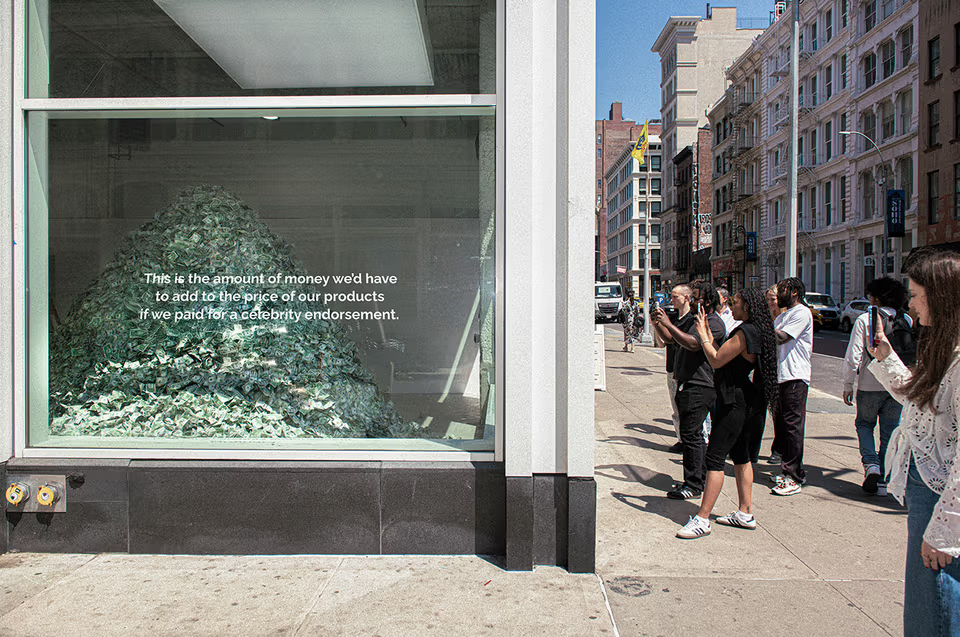
The brief: defend The Ordinary's science-first, no-celebrity positioning in a beauty category increasingly dominated by influencer mark-ups. Uncommon opened a pop-up store where price tags showed not what the product cost, but what the influencer endorsement behind it cost — piles of fake money as décor, the gap between formula and fame made physical and unavoidable. The category's invisible logic — that premium skincare earns its price through association rather than ingredient — was the product that went on display. The Ordinary didn't need to make a claim. It just turned the category rule into the exhibit.
The Zeeman Sneaker Experiment (2020) launched two shoes simultaneously — one hyped at €200, the other at €12.99 — before revealing that both were the same, generating over 90 million impressions and a resale market that spiked to €500. The category rule exposed: hype, not product, sets the price. Sparkasse's Jung von Matt (2024) used AR to convert in-game purchases back into real euros — reframing digital spending habits as a financial blind spot the category had been quietly enabling.
2. Push the Logic to Parody
Follow the category's worst assumption all the way to its absurd conclusion — and let the audience arrive there with you.
Cargo Passenger Class — Flyadeal, 77 Media, 2019
The brief: reframe low-cost air travel in Saudi Arabia, where the perception of budget airlines was synonymous with poor quality and a loss of dignity. To do so Flyadeal invented a fake "Cargo Passenger Class" — no seats, no dignity, passengers standing in the hold — with posters, videos, and a full fake booking site selling the non-existent product. Once the absurdity was complete, the reveal landed cleanly: Flyadeal offers genuinely low fares, just with actual seats. The campaign drove a sevenfold increase in web traffic. See campaign ->
Catapult Air (Sylt Tourism, Philipp und Keuntje, 2019) launched a satirical airline that proposed catapulting visitors to a poorly connected German island — embarrassing politicians, and triggering €221 million in real rail investment.