


Most brainstorming starts too late.
We’re given a problem and immediately start looking for solutions.
Get more people exercising.
Make insurance feel relevant.
Persuade people to switch banks.
And, before anyone has asked whether we’re solving the right problem, someone has requested 20 campaign ideas.
AI is especially good at this.
It can misunderstand a brief at quite extraordinary speed.
But the problem written in the brief is only one way to look at it.
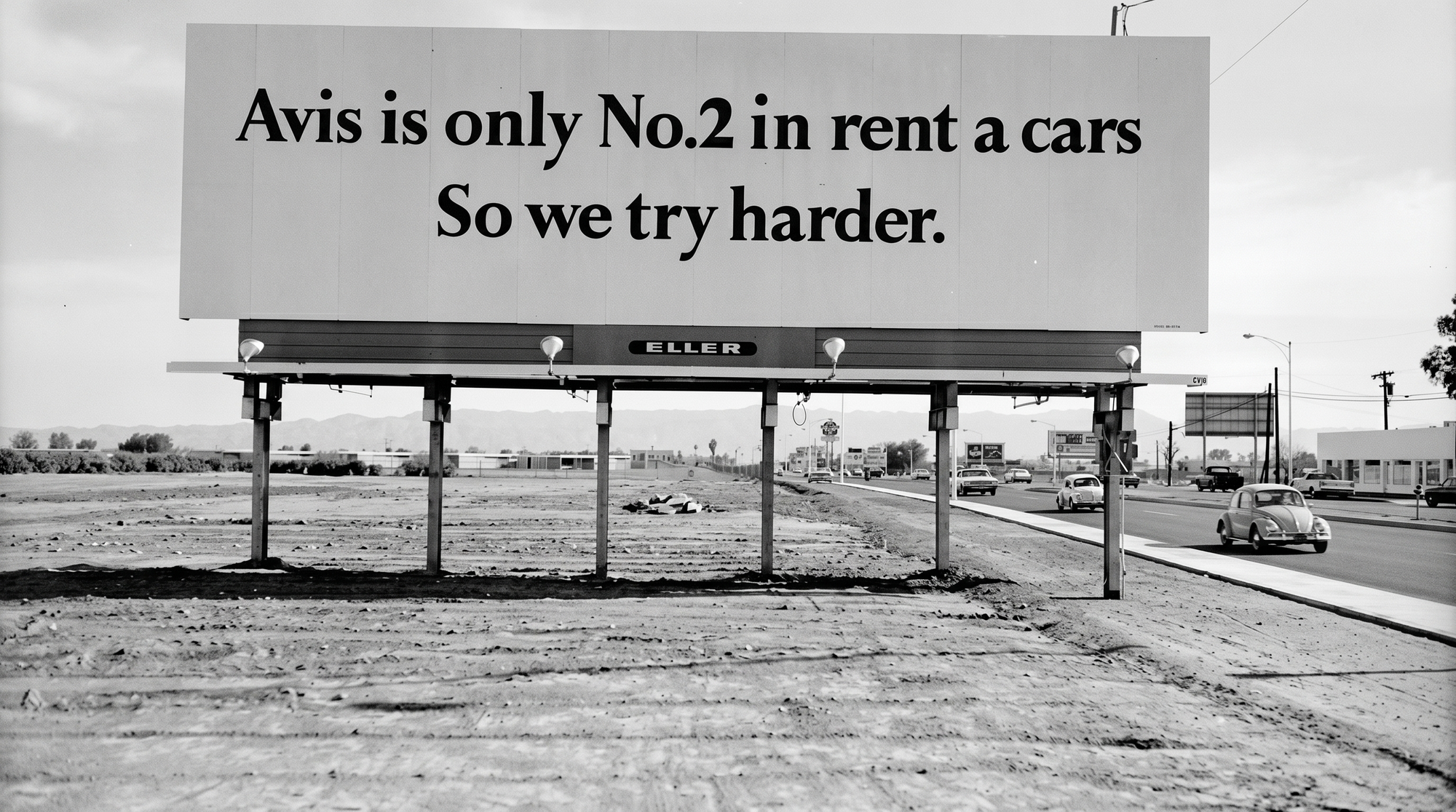
Avis was number two in car rental. That sounds like a weakness until being number two becomes the reason you have to try harder.
The fact didn't change.
The interpretation did.
The BITW Creative Operating System gives strategists and their AI different ways to question a brief before generating ideas, using repeatable reframing moves reverse-engineered from great advertising.
We Don't Value Things. We Value Their Meaning.
Rory Sutherland puts the psychological case for reframing neatly:
“We don't value things; we value their meaning.”
Payless demonstrated the point rather spectacularly.
For Palessi, the discount shoe retailer removed its own branding, opened a fake luxury boutique and invited fashion influencers to judge its shoes as though they belonged to a new designer label.
They praised the craftsmanship and placed dramatically higher values on exactly the same shoes.
Nothing about the shoe justified the new price.
The luxury context did the work.
That's useful territory for a strategist.
The same price can feel expensive or cheap depending on what it is compared with.
The same weakness can look like a flaw or a reason to believe.
The same ordinary product can become mysteriously “premium” once someone puts it on a plinth and lowers the lighting.
The thing hasn’t changed.
The frame has.
Before AI Starts Solving
Give AI a brief and it will start answering it.
Admirably efficient.
Unfortunately, it won’t always stop to ask whether the brief deserves an answer in its current form.
Ask for campaign ideas to get people exercising in January, and it can immediately give you challenges, influencers, rewards, resolutions and fitness goals.
But it still explores the assumptions in the original brief.
The BITW Creative Operating System puts another step first:
What are the different ways this problem could be understood?
Explore the frames first.
Then generate against the versions that open up somewhere interesting.
What Actually Counts as a Reframe?
Changing the execution isn’t reframing.
Neither is changing the typeface, making the copy cheekier or asking AI for “a more disruptive angle”.
A useful reframe changes the audience’s judgement.
Something undesirable becomes desirable. A weakness becomes evidence. A mundane behaviour gains status. A price feels different because the comparison has changed.
Reframe Anything finds those shifts inside campaigns that already worked, strips away the execution and turns the underlying move into a question you can use on another brief.
Three examples show how different that change can be.
Joe Boxer — Inactivity Tracker
Fitness trackers were obsessed with movement, steps and constant optimisation.
A pyjama brand's truth was the opposite.
So Joe Boxer launched an inactivity tracker: a spoof wearable that logged and rewarded doing absolutely nothing.
Instead of competing inside the category's definition of achievement, the brand rejected it.
Rest stopped looking like failure.
For Joe Boxer, rest was the point.
MoneySuperMarket — Epic Action Man
Saving money on insurance is useful.
It doesn't normally feel heroic.
MoneySuperMarket changed the emotional frame.
Epic Action Man turned saving money on tank insurance into an extravagantly cinematic victory, making the feeling of getting a good deal wildly bigger than the functional act itself.
Saving didn't become more important.
It became something to swagger about.
Suzuki — Selling Cars by the Kilogram
During a cost-of-living crisis, a car is often the last thing people consider.
So, Suzuki changed the comparison.
Selling Cars by the Kilogram compared the price of a Vitara with supermarket staples including prawns, cheese and raspberries.
The car stopped sitting only inside the automotive category.
It suddenly sat beside the weekly shop.
Change the reference point, and you can change the perception of value.
15 Repeatable Ways to Change the Frame
There is more than one way to look at a brief.
We found 15 that turn up repeatedly in effective advertising.
Some change what a choice says about you. Some change who gets to speak. Others change the enemy, the comparison, the category rule or the meaning of the behaviour itself.
One of them may improve your brief.
Running all 15 indiscriminately may simply give you a very long afternoon.
Reframe Status
Change what a choice signals about the person making it.
Reframe Shame into Pride
Turn something people hide, apologise for or feel embarrassed by into something worth displaying.
Reframe the Insult
Take the criticism, label or slur and make it carry the opposite meaning.
Reframe Uncool
Stop trying to escape what makes something uncool and find a reason to value it.
Luxury Deception
Remove the label, borrow higher-status codes or disguise the source so the product can be judged before prejudice arrives.
Reframe Who the Hero Is
Move attention away from the protagonist the category would normally celebrate.
Reframe the Roles
Change who teaches, buys, sells, decides, serves or holds authority.
Reframe Who's Talking
Find a messenger whose perspective changes how the argument lands.
Reframe Category Logic
Question a rule the category has quietly trained everyone to accept.
Reframe the Battle
Change what the brand or audience is really fighting against.
Reframe Meaning
Give a familiar word, object or behaviour different emotional or cultural weight.
Reframe Dull
Find a more interesting way to interpret something familiar, worthy or functional.
Reframe the Cultural Moment
Don't merely join the conversation. Change what the moment appears to be about.
Reframe the Ritual
Hijack, invert, relocate or reinvent a familiar repeated behaviour.
Reframe Value
Change the comparison, benchmark or reference point that determines what something feels worth.
Fifteen different strategic ways to disturb the first version of the brief.
Not every tactic will fit every problem.
That's the point.
The job isn't to force a brief through all of them and accept whatever comes out.
It's to use them to discover which frames make the brief more interesting.
Give Your AI Better Problems to Solve
The BITW Creative Operating System works with ChatGPT, Claude or Gemini.
Give it your brand, audience, objective and context, and it will find more interesting versions of the problem before generating solutions.
No new platform. No course to finish first. No dashboard that would like to show you around.
Upload it. Add your brief. Start reframing.