


Reframe the Cultural Moment

Seven ways to find a cultural moment and change what it points at.
Reframe the Cultural Moment

Every culture generates moments that already carry emotional charge: songs people know by heart, trends everyone's participating in, events the whole world is watching, formats so familiar the audience finishes your sentences. Trying to create that kind of recognition from scratch is a thankless task. The smarter move is to find it where it already exists and change what it points at. Here are seven reframe tactics that know exactly how to flip the signal.

  1. Redirect the Cultural Conversation
  2. Reverse the Emotion in a Familiar Format
  3. Hold a Mirror Up to a Format Until It Cracks
  4. Enter a Live Cultural Conversation From the Opposite Direction
  5. Oppose a Live Cultural Behaviour
  6. Intervene in a Live Cultural Behaviour
  7. Use a Cultural Event’s Gravity Without Buying a Ticket

1. Redirect the Cultural Conversation

Borrow the emotional charge of a live cultural debate and use it to expose a different crisis entirely.

I Want AI to Take My Job — UNICEF, 2026
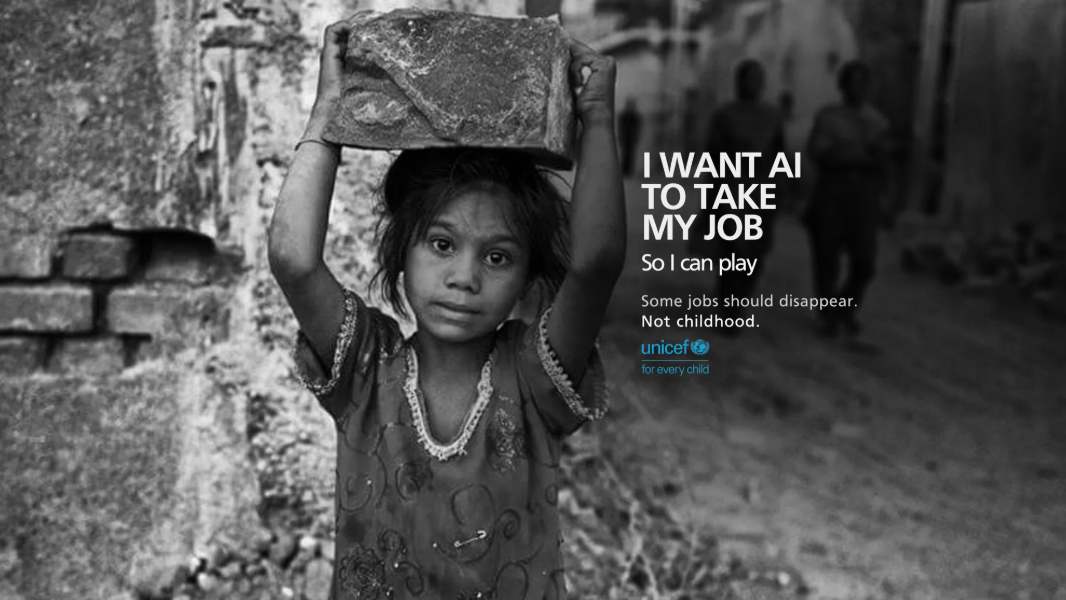
The AI job displacement conversation is one of the loudest anxieties running through culture right now. Adults across developed economies are asking what automation means for their careers, their relevance, their income. UNICEF's I Want AI to Take My Job (2026) walks straight into that anxiety and switches the subject. The campaign uses the sentence everyone expects to hear from a worried adult and gives it to a child in a factory, a workshop, a construction site. The ask — "So I can go to school," "So I can play," "So I can be a child" — repoints the fear toward a crisis that predates the AI debate by decades. The closing line, "Some jobs should disappear. Not childhood," lands without overexplaining. UNICEF doesn't argue against automation. It uses the conversation about automation to make child labour impossible to look past.


2. Reverse the Emotion in a Familiar Format

Take a format, song, or cultural ritual already loaded with feeling then use it to make the audience feel the opposite.

We Are The Champions — Fondation 30 Millions D'Amis, McCann, 2019

France holds the record for the highest number of abandoned animals in Europe. It's a statistic that had failed to generate meaningful public engagement until McCann Paris found the right emotional lever. The campaign used Queen's 'We Are The Champions': a song so thoroughly associated with collective triumph, national pride, and sporting joy that its meaning felt fixed. The film shows French pet owners abandoning their animals while a sombre, stripped-back version of the anthem plays. The contrast between what the song usually signals and what it was now illustrating made the dissonance (and collective shame) impossible to ignore. The campaign galvanised national attention around animal welfare by transforming a celebratory anthem into a call for responsibility. See campaign ->

Sandy Hook Promise's Teenage Dream (Human Music & Sound Design New York, 2022) reworked a joyful, nostalgic Katy Perry pop anthem into a vehicle for mourning the emotional toll of gun violence on American youth. Pregnant Then Screwed's #UnhappyMothersDay (Wonderhood Studios, 2022) used the same inversion on a format rather than a song — Mother's Day cards designed to celebrate were redesigned to expose the financial cost of UK childcare and the motherhood penalty, turning the occasion's warmth into the sharpest possible delivery mechanism for the argument.
3. Hold a Mirror Up to a Format Until It Cracks

Reproduce a familiar format so accurately that the audience finally sees it clearly for the first time.

This Is A Generic Millennial Ad — Dissolve, And/Or, 2018

Millennial-targeted advertising had collapsed into a set of shared visual clichés; the golden-hour footage, the diverse friend groups, the hands reaching toward something, the aspirational voiceover about authenticity. Dissolve, a stock footage company, made a film called 'This Is A Generic Millennial Ad' that reproduced every one of those tropes in sequence with deadpan commitment. The twist: every clip in the ad came from Dissolve's own stock library. The campaign achieved two things simultaneously. It exposed the hollow mechanics of an entire advertising genre, and it demonstrated that Dissolve supplied the visual language those ads were built from. The meta-awareness landed as both cultural critique and product proof. Viral traction followed, positioning Dissolve as the brand that understood the industry well enough to be in on the joke. See campaign ->

Beats by Dre's 'This Is a Beats Ad' (Rosewood Creative Los Angeles, 2022) worked the same fourth-wall mechanism on TikTok — creators performing over-the-top influencer-ad tropes while openly naming what they were doing. Samsung's The Interns (BBH, 2023) made the process of pitching the ad, the content of the ad. All three campaigns share a single insight: the moment a format becomes so familiar it's invisible, naming it is the most disruptive thing you can do. The mirror isn't cruel. It's just honest.


💡
Want to give your own AI a sharper sense of comparative value? Sign up for free, and I'll give you your own Reframe Value Engine.

4. Enter a Live Cultural Conversation From the Opposite Direction

Find the trend a niche is participating in, then join it from the other end and make that the brand's position.

#littlemoneybigfun — KFC Romania, McCann, 2015

#RichKidsOfInstagram was a live cultural moment built on the conspicuous display of wealth. Meanwhile, KFC Romania was launching its cheapest-ever meal and needed to reach young audiences who valued fun over money. McCann's response wasn't to challenge the trend, it was to enter it from the opposite end entirely. The campaign launched #LittleMoneyBigFun, inviting fans to recreate lavish, rich-kid Instagram shots with their own low-budget versions through a dedicated website. The parody wasn't mean-spirited; it was participatory, inclusive, and built on the same social logic as the original trend — look what I've got — just pointed somewhere more accessible. It engaged younger audiences directly and positioned the budget meal as a badge of smart fun rather than a compromise.


5. Oppose a Live Cultural Behaviour

Challenge something people are currently doing, then use the opposition to strengthen a relevant brand or product truth.

Leave the Flame-Grilling to Us — Burger King, 2026

Hot weather created the context. Tannaxxing supplied the behaviour. Rather than simply producing another reactive heatwave ad, Burger King opposed the emerging practice of deliberately exposing yourself to extreme sun while appropriating the language surrounding it. People grilling themselves became the wrong kind of flame-grilling.

That distinction gave Burger King's long-standing product truth fresh cultural relevance. Humans shouldn't be grilled. Burgers should. The campaign therefore does two jobs simultaneously: it rejects a live cultural behaviour while stealing the wider cultural conditions surrounding it to make Burger King's flame-grilling credentials newly salient.

Sojasun's Manosphere Protein Troll (2026) similarly pushed against protein-obsessed manosphere culture while using that same obsession to make soy's own protein credentials relevant. The cultural behaviour provides both the enemy and the opportunity.


6.Intervene in a Live Cultural Behaviour

Find something people predictably do around a cultural moment, then change the rules, rewards, friction or consequences around it.

No Returns Resolution — Decathlon Canada, Rethink, 2026

January produces a familiar cycle: make a fitness resolution, buy the gear required to become your new self, then gradually abandon the ambition. Decathlon intervened inside that behaviour rather than merely advertising against it. Its No Returns Resolution turned the return policy around selected running shoes into a commitment device. If customers had decided to become runners, the brand wasn't going to make quitting quite so easy.

The retail mechanic became the cultural intervention. Decathlon didn't simply comment on New Year's resolutions. It changed one of the rules surrounding the behaviour, using commerce to make sticking with the resolution more likely.

Oatly's Bike Thru (2026) intervened in Amsterdam's deeply embedded cycling behaviour by redesigning the drive-thru around bikes rather than cars. Instead of asking cyclists to adapt to an existing retail convention, the brand changed the service to fit the cultural behaviour.


7. Use a Cultural Event's Gravity Without Buying a Ticket

Let a massive cultural moment do your media work by making your absence from it the campaign.

If We Made It — Newcastle Brown Ale, Droga5, 2014

Newcastle Brown Ale couldn't afford a Super Bowl ad slot and couldn't secure one. Droga5 turned the constraint into a strategy. Rather than ignore the Super Bowl's cultural dominance or run a campaign adjacent to it, Newcastle built an entire campaign around the ad they hadn't made. They launched IfWeMadeIt.com, hosting teasers, trailers, and behind-the-scenes footage featuring Anna Kendrick and Keyshawn Johnson for a fictional Big Game spot that didn't exist. The campaign generated widespread media coverage and consumer engagement without the cost of a real Super Bowl placement. The Super Bowl's cultural gravity — the shared understanding that this is where brands go to make their biggest statement — did all the heavy lifting. Newcastle just pointed at it from the outside and made that pointing the idea. See campaign ->

For The Greater Hood's Empty Hangers (Six+One, 2026) used New York Fashion Week's obsession with clothing to draw attention to people without enough of it. The campaign placed 17,000 empty hangers across the city, turning a familiar fashion symbol into evidence of clothing insecurity. It didn't need access to Fashion Week itself; the event made clothing unusually culturally salient, and the campaign redirected that attention towards its absence.

ALDI's Fake Moss (McCann Manchester, 2024) used the same logic at a different kind of event. When Chanel brought its Métiers d'Art show to Manchester — usually held in Paris or Milan — the city filled with celebrity A-listers. McCann Manchester sent in a Kate Moss lookalike, Denise Ohnona, not to the show but to an ALDI. The sighting spread immediately on social media, with fashion fans debating what was in Moss' shopping basket before the stunt was revealed and confirmed by the local press. The stunt worked because the celebrity sighting was genuinely plausible — Moss had every reason to be in Manchester that week — and the contrast between that glamour and a budget supermarket was the entire joke. ALDI didn't gate-crash the fashion world. It let the fashion world come to it.


The One Rule

The cultural moment has to be doing real emotional work before you arrive. Find the cultural gravity. Change the direction.


Want Your AI to Think This Way?

These tactics come from the Reframe Anything Engine, one of a growing library of Thinking Engines built to make your AI more creative. Upload it to ChatGPT, Claude or Gemini and give your AI the campaign logic it needs to explore unexpected territories, reframe briefs, generate stronger ideas and pressure-test the ones worth pursuing.

Subscribe to Big Ideas That Work for free tools and updates.

Join today, and we’ll send you the awesome Reframe Value tool.
Great! Check your inbox and click the link to confirm your subscription.
Error! Please enter a valid email address!