


AI doesn't necessarily give you bad ideas.
It just gives you the same ideas, dressed differently.
The BITW Creative Operating System gives the AI you already use somewhere useful to go next.
Give it the brief. Let the system find the interesting way in.
Download the system and be up and running in minutes when you join BITW Mischief Maker Pro membership.
Works with ChatGPT, Claude and Gemini.
Three Ways to Work
The system has three operating modes.
You can use one from the start or move between them as the work develops.
Strategy Mode
Use this when you need to work out where the real opportunity is before jumping into ideas. The system interrogates the brief, separates facts from assumptions, identifies the dominant blockage and looks across the Engines for the most promising ways in.
Brainstorm Mode
Use this when you want range. The system deliberately explores the brief across different Engines, tactics and mechanisms rather than producing twenty executions built from the same underlying thought.
Focused Brainstorm Mode
Use this when you have found an interesting territory and want to push it much further. You can ask the system to stay inside one creative territory and explore the range properly.
Five Specialist Engines Inside One System
Each Engine is built around a different kind of creative problem. They work independently when you need focus and together when a brief benefits from more than one way of thinking.
Shift Perception
For briefs where the product, category, behaviour or audience is being seen through an unhelpful frame.
The Engine can help identify ways to change meaning, identity, perspective, comparison, belief or conflict.
Inside: 6 diagnostic routes and 36 canonical creative tactics, supported by Better Questions and campaign precedents.
Make It Famous
For briefs where the point is correct but too abstract, familiar, hidden or easy to ignore.
The Engine looks for ways to make the benefit felt, make the abstract visible, let reality prove the point, give the idea a character, make the format carry the argument or let the wrong answer reveal the right one.
Inside: 6 ways to make the point land, with specialist tactics, Better Questions and campaign precedents spanning metaphor, proof, personification, media, parody and more.
Change Behaviour
For briefs where the audience already knows enough but still does not act.
The Engine identifies the behaviour you can actually observe, the behaviour you need instead and the barrier currently winning. Then it looks for ways to make the action easier, timelier, more rewarding, more socially acceptable, more consequential or more repeatable.
Inside: 6 behavioural routes and 27 tactics for changing the conditions around what people actually do.
Build Fandom
For briefs where attention is not enough.
The Engine looks for the behaviours that turn an audience into participants: recognition, rituals, mysteries, status, fan expertise, co-creation, symbols of belonging, shared lore and opportunities for fans to enter or extend the brand world.
Instead of asking how to get more people to see the campaign, it asks what committed people might want to do with it.
Inside: 14 fandom mechanisms supported by 86 campaign precedents.
Creative Commerce
For briefs where buying, trying, paying, earning, redeeming, visiting or exchanging value could become part of the creative mechanism.
The Engine looks beyond the promotional message and asks whether the transaction itself can carry the strategy.
Inside: 18 commerce areas and 169 canonical campaign precedents covering everything from alternative currency and creative payment to retail, rewards, trial, social selling and creator-led conversion.
Built Around Better Questions
The system does not start with:
Give me 50 ideas.
It starts by finding better questions to ask of the brief.
Questions such as:
What assumption is making this product look ordinary?
What does the audience already do that proves the problem?
What would make the benefit visible without explaining it?
The question changes the search space.
The Engines then provide your AI tactics, mechanisms, and campaign precedents to help it answer that question in different ways.
That is how the system gets past the first plausible answer rather than merely rewriting it.
Built From How Campaigns Actually Work
The BITW Creative Operating System is built from the same underlying system used across Big Ideas That Work.
Campaign Spotlights identify reusable moves inside new work.
Tactic articles explain those moves in more depth.
Better Questions turn the mechanism into something you can apply to another problem.
The Engines organise those tactics around the jobs a live brief might need them to perform.
And the campaign banks give the AI structurally relevant precedents to retrieve when it needs evidence, comparison or inspiration.
They help the system recognise relationships that travel.
A saving button beside an online checkout does not mean every financial brief needs a browser extension.
A fan reward does not mean every audience needs a loyalty scheme.
A metaphor does not mean every proposition needs a visual pun.
The useful question is:
What made that move work, and could the same relationship solve this brief differently?
New Campaigns. New Ways In.
The Operating System gives your AI a structured way to work the brief.
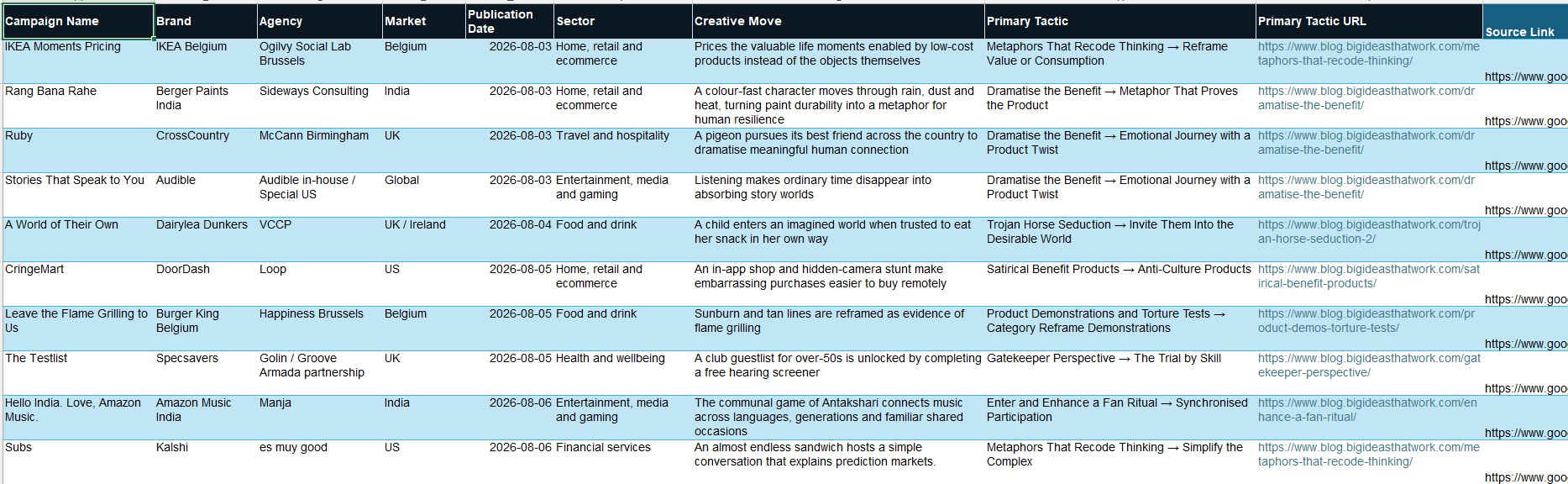
The Monthly Campaign Tracker keeps the evidence underneath it fresh.
Every month, BITW reviews the most interesting new campaigns and classifies the useful ones using the same tactic definitions and Engine boundaries built into the system.
Upload the latest Tracker to your AI project, and it gains access to a growing bank of current campaign precedents — already organised by the problem they solve, the mechanism they use and where they fit inside the Operating System.
Plenty Under the Bonnet.
The download includes:
- all five BITW creative Engines;
- the operating instructions that route briefs across them;
- Strategy, Brainstorm and Focused Brainstorm modes;
- Better Questions embedded throughout the system;
- campaign precedent banks built for AI retrieval;
- tactic definitions and sub-tactic distinctions;
- collision rules that help separate similar mechanisms;
- quality controls designed to challenge familiar or weak routes;
- instructions for combining tactics without producing creative soup;
- guidance on proof, feasibility, ethics and assumptions.
You do not need to know any of the above.
You just upload the five files and the project instructions provided to your AI, and you're all set.
Use It With the AI You Already Have
- Download the BITW Creative Operating System.
- Upload the supplied files to a ChatGPT Project, Claude Project, Gemini workspace or equivalent.
- Add the supplied operating instructions.
- Paste in your brief.
- Choose Strategy, Brainstorm or Focused Brainstorm Mode — or simply ask the system where it thinks you should start.
Your AI remains your AI.
It just has more interesting ways to work the problem.
The System Keeps Moving
The BITW Creative Operating System is available through Mischief Maker Pro membership.
When you join, you receive the complete system to download and use with the AI of your choice.
As new campaigns reveal useful mechanisms, tactics are sharpened, Better Questions improve, and the Engines are tested against harder briefs, the files are updated too.
You receive the new versions while your membership is active.
So the system does not remain frozen on the day you download it.
It keeps learning from the same growing body of work behind Big Ideas That Work.
Download it. Upload it. Give it a brief.
NAQs: Never Asked Questions
The things we think are actually worth knowing before you use the system.
Doesn't AI already know how to come up with creative ideas?
Yes. And sometimes good ones.
The problem isn't that AI has no ideas. It's that, left to its own devices, it can circle the same obvious territories, dress one thought up ten different ways or jump around fairly randomly.
The BITW Engines give it more places to think from.
Not more creativity on tap. More systematic ways to find it.
So does BITW actually make AI more creative?
AI already has an enormous amount of creative knowledge buried inside it. What BITW does is organise proven creative moves so AI can explore them deliberately rather than hoping it stumbles across them.
The difference is less: Wow. AI can suddenly think.
And more: Interesting. We've got 12 genuinely different ways into this problem.
Couldn't AI eventually get to most of these ideas anyway?
A monkey could write a Shakespeare play. Eventually.
The value of BITW is making that exploration less random, less repetitive and much faster.
If I can download the system, why should I keep subscribing?
Because the Operating System is the starting point.
Every month, BITW reviews the most interesting new campaigns and classifies the useful ones using the same tactics, Engine boundaries and retrieval logic built into the system.
Pro Members receive an updated Campaign Tracker ready to add to their AI project.
Replace the previous tracker with the new one and your Operating System immediately has access to a growing bank of current campaign precedents — already tagged by the problem they solve, the mechanism they use and the Engines they are most relevant to.
General AI can find campaigns, summarise them and sometimes make very good connections.
What it won't have is a maintained, cumulative body of recent work already classified against the same system you are using on your brief.
That is the advantage.
AI can find examples. BITW has already decided why they matter.
Why does the system use campaign precedents?
Because examples help AI recognise how a strategic move has worked in the real world.
But the banks are not organised simply by category, brand or execution. Each campaign is structured around the problem it faced, the mechanism that made the idea work and what can transfer to another brief.
That matters because general AI is much more likely to retrieve by surface similarity than by structural similarity.
Ask it about a pet-food brief and it may give you more pet-food campaigns.
BITW is designed to ask a different question:
What other campaign solved a similar underlying problem, even if it came from a completely different category?
That means a financial-services campaign might be useful for a pet-food brief if the same mechanism is at work.
The system retrieves the relationship, not just the reference.
Does it separate divergent and convergent thinking, or just generate a pile of ideas?
Aha, you're clearly a strategist. Welcome!
Yes, it does.
In Brainstorm Mode, the system deliberately creates a wider internal pool before deciding what deserves to survive.
It is instructed to generate more than it returns, then cut hard.
The aim is not 50 ideas for the sake of saying you have 50 ideas.
It is to explore enough genuinely different territory to find the few routes worth taking into the room.
Is this just a bunch of familiar strategy frameworks bundled together?
Not at all.
Plenty of useful frameworks already exist, and BITW doesn't pretend to have invented inversion, reframing, behavioural friction, divergent thinking, or premortems.
The difference is what happens when those principles connect to a working system of creative Engines, tactic distinctions, Better Questions, and campaign precedents.
The framework tells you how you might think.
BITW helps your AI actually do that thinking on the brief in front of you.
Does it work as well on tough briefs?
It works better.
Simple briefs are easy for AI, too.
Ask an AI to sell cat toothpaste, and there are plenty of fun places it can go. There's very little stopping it.
Give it a parity product, a sceptical audience, an entrenched behaviour, three category clichés it can't use and a proposition every competitor could claim, and things get more interesting.
The harder the brief, the more valuable it becomes to have somewhere useful to go next.