

Getting to an idea worth fighting for rarely begins from an obvious starting point. Inspired by former Wieden+Kennedy Creative Director Jason Bagley, this series uses provocative questions to direct the Big Ideas That Work Engines for the repeatable creative tactics that can help answer them.
This time, we’re asking:
What benchmark could make our advantage impossible to miss?
Here are seven campaigns that probably weren't thought of by asking this question and a few others, but they could have been...
- Expose the Cost Others Conceal
- Translate Value Into Everyday Terms
- Invent a More Revealing Unit
- Re-rank an Established Measure
- Measure the Challenge That Really Matters
- Make Your Product the Category Standard
- Let Customers Establish the Record
1. Expose the Cost Others Conceal
Find an expense the category normally keeps out of sight and put it where customers expect to see the price.
The Cost of Influence — The Ordinary, Uncommon, 2025
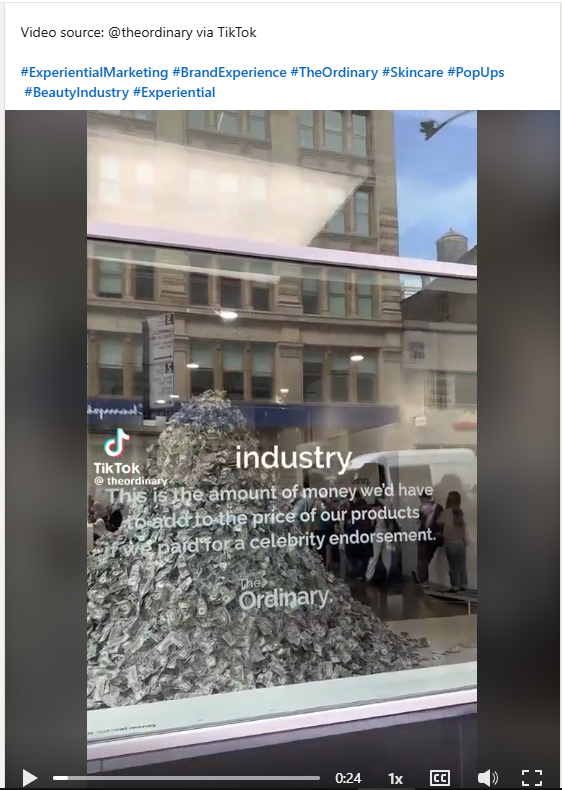
Beauty products are usually compared by their retail prices. That leaves a more revealing question unanswered: how much of the price pays for the formulation, and how much pays for the person promoting it?
The Ordinary opened a New York pop-up that displayed competing products alongside estimates of what influencer endorsements had added to their cost. The price labels effectively itemised the category theatre customers were being asked to fund.
The benchmark worked because it favoured the business model, not merely an individual product. The Ordinary had built its reputation around clinical ingredients, transparent pricing and little reliance on celebrity endorsement. Once marketing expenditure became part of the comparison, its lower prices looked less like evidence of lesser quality and more like evidence of different priorities.
The question that could have produced it:
What are customers paying for that our category prefers not to itemise?
The creative move: Replace the Price with the Hidden Mark-Up, from the Creative Commerce Engine → Showroom Subversion and Reality Installations
2. Translate Value Into Everyday Terms
Replace a price people have to consider with a familiar expense they barely notice.
It’s That Affordable — IKEA, Memac Ogilvy & Mather, 2016
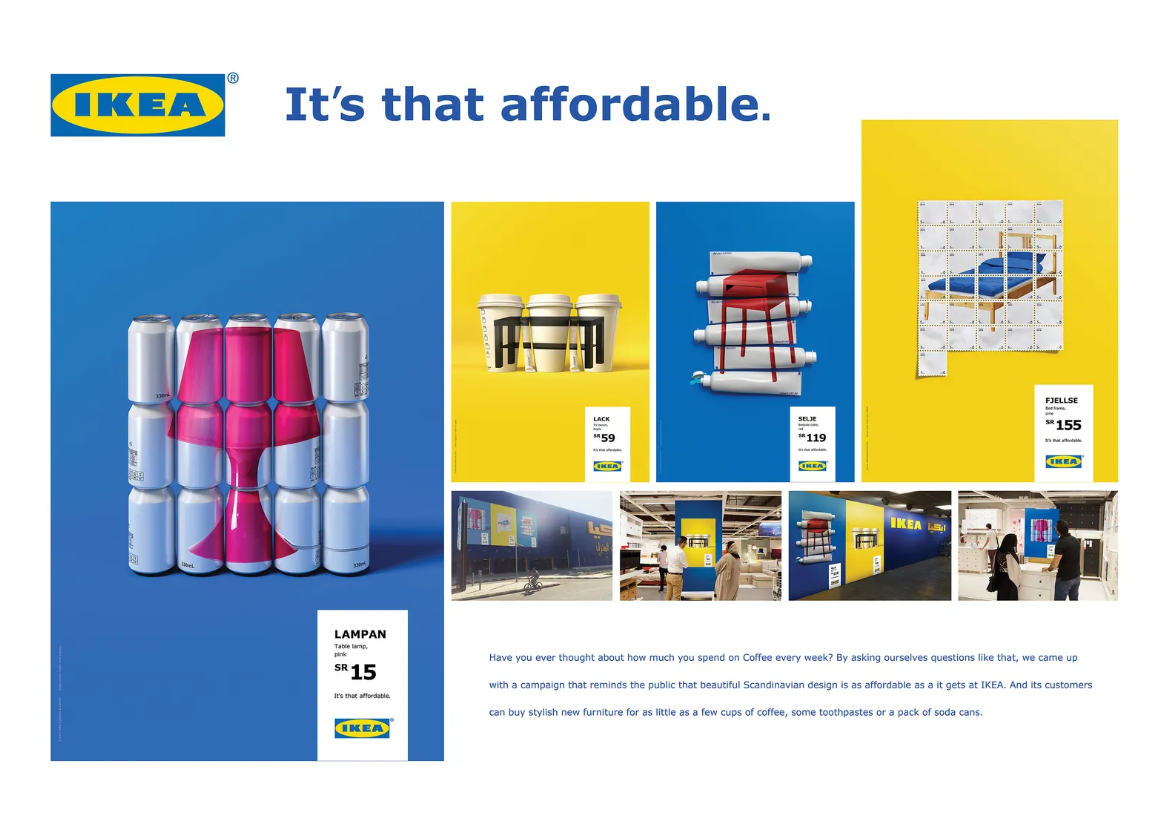
The price of a table feels like a furniture purchase. The price of a few coffees feels like part of an ordinary week. IKEA used the second to reframe the first.
Its campaign constructed images of IKEA products from everyday purchases that cost the same amount. Three coffees became a table. Several tubes of toothpaste became a bedside cabinet. Instead of asking people whether the furniture was affordable, the work showed what its price already resembled in their lives.
This is what makes a useful benchmark different from a cheap-price claim. Comparing it with familiar, low-friction spending supplies an answer before the audience has to calculate one.
The question that could have produced it:
What do people already spend the same amount on without thinking twice?
The creative move: Anchor Value to a Familiar Measure, from the Strategy Engine → Salient Anchoring
3. Invent a More Revealing Unit
Turn a statistic people have learned to ignore into a unit they cannot forget.
So Many Dicks — e.l.f. Beauty, OBERLAND, 2024
Corporate diversity data has a presentation problem. Percentages can reveal serious inequality while still sounding like material for an annual report. e.l.f. Beauty found a more memorable unit.
Research into almost 37,000 board members at US-listed companies identified 566 men called Richard, Rick or Dick. That figure was then compared with the number of Black, Asian and Hispanic women serving on those boards. The campaign displayed the results around Wall Street under a headline that made the imbalance difficult to politely overlook: So Many Dicks.
The familiar male name became a unit of institutional inequality. It reduced a sprawling dataset to one absurd comparison and, in doing so, made e.l.f.’s own diverse board look radically unlike the corporate norm.
The benchmark was provocative, but not gratuitous. Its bluntness matched the absurdity it uncovered.
The question that could have produced it:
What unexpected unit would expose the absurdity hidden inside the usual statistic?
The creative move: Put the Contradiction Side by Side, from the Strategy Engine → Absurdity of the Status Quo