
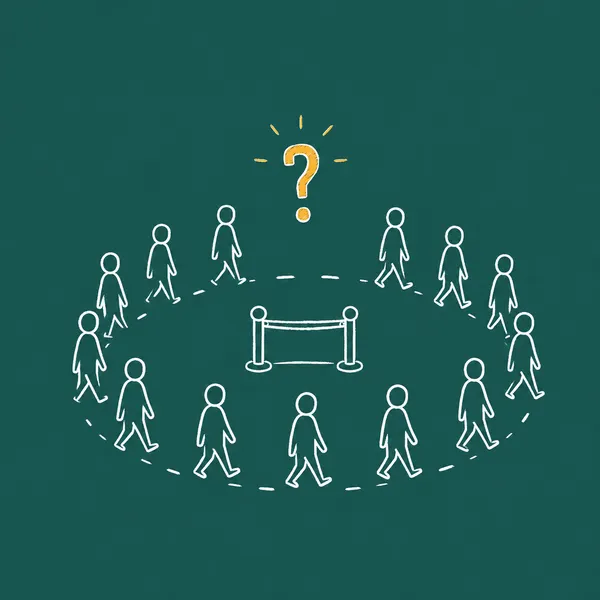
What happens if you take the excuse seriously? What happens if you obey the rule exactly? What happens if you turn the statistic into an object, the policy into a character, or the future consequence into a product someone could buy? That is the power of Absurdity of the Status Quo: it does not invent the madness. It makes the existing madness visible. Here are nine tactics from the Creative Engine that make the existing reality look... ridiculous.
- Satirical Exaggeration
- Literalise the Problem
- Symbolic Artefacts
- Make the Data Real
- Absurd Comparison
- Bureaucratic Absurdity
- Corrupted Familiar Format
- Satirical Beneficiary
- Absurd Future
1. Satirical Exaggeration
Push the accepted logic all the way — till it breaks.
The Ridiculous Run · Adidas · TBWA NEBOKO · 2023 · Global
Women's safety while running has been normalised as a woman's problem — something to be managed through precaution and planning. Adidas exaggerated those workarounds until they looked absurd: a woman jogging through a city with a full motorcade, suited agents, earpieces. The execution helped shine a light on the real scandal; why the problem should exist in the first place.
Wood Milk · MilkPEP · Gale · 2023 · USA — invented a fake plant-based milk made from wood, presented in deadpan using the exact format and register of alternative milk advertising. The parody followed the category's own logic — anything can be milk. Quit the Denial · Ontario Ministry of Health · BBDO · 2015 · Canada — translated the excuse "I only smoke socially" into an equivalent behaviour with no social glamour. The excuse, transferred intact, became too absurd to repeat with a straight face.
"Progress is about challenging the status quo. The only way you progress is you challenge what's out there." Sir John Hegarty
2. Literalise the Problem
Act out the hidden logic of the norm — and let the audience see where it actually leads..
The Unlevel Playing Field · Puma · BETC · 2022 · Brazil
Women's football in Brazil operates on structurally unequal terms. Puma built an actual football pitch on an incline and invited male players to play on it. The argument that had been dismissed as abstract — that the playing field is not level — became something players physically struggled against in real time. The metaphor that the culture already used for the problem became the problem, made real.
Hype Magazine and the Tears Foundation, working with TBWA Hunt Lascaris Johannesburg, made the logic of victim-blaming literal in a 2020 film: a woman physically assaulting herself, because that is what victim-blaming implies when followed to its conclusion. The campaign reached 240 million people and influenced police and school policies. March For Our Lives and McCann New York put a child in front of a room of adults in 2019 to calmly teach them how to survive an active shooter situation — using knowledge she had acquired at school. The inversion made the scandal impossible to look past: children had become the experts.
3. Symbolic Artefacts
Turn the abstract truth into an object people can hold, wear, confront, or stand in front of.
Bulletproof Posters · Americans for Responsible Solutions · Ogilvy & Mather Chicago · 2017 · USA
US gun laws were so weak that campaign posters needed to be bulletproof. So the brand made them bulletproof — actual posters embedded with .44 magnum rounds, placed outside government buildings. The posters did not describe the problem. They were what the problem looked like when taken at face value. The medium became the evidence.
Change The Ref and Leo Burnett staged a graduation ceremony in 2021 for students killed by gun violence. Thousands of empty chairs. The absence became the artefact — a civic memorial dressed in the optimism of a future the students were denied. March For Our Lives turned the average value of NRA political donations per student into wearable price tags, worn by young protesters in 2018. A hidden calculation became a public moral indictment. 2.2 billion media impressions followed.