
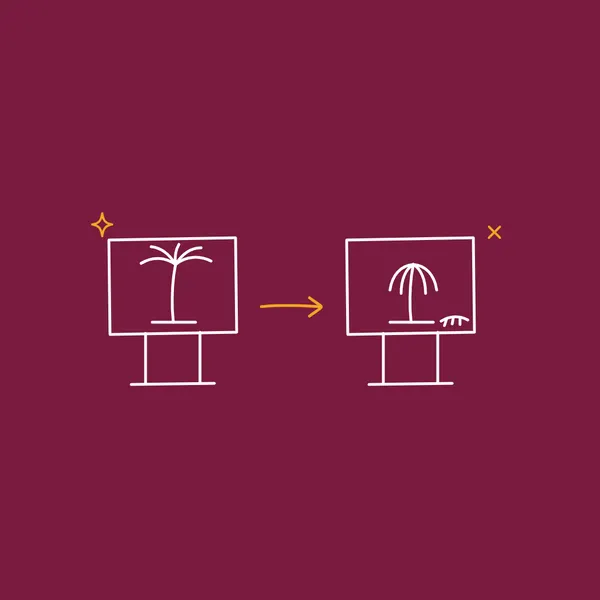
Media Consequence Metaphors take something people already look at, carry, or walk past and alter it to show the damage still to come. A gift card carries an extinction date. A city's favourite palm tree dies. A girl's story falls apart halfway through a sentence. What matters is the change: let a medium people already trust show where things end up, and nobody has to imagine the outcome.
- Encode the Future Outcome in the Medium
- Let the Medium Deteriorate or Disappear
1. Encode the Future Outcome in the Medium
Alter a recognised medium or symbol so it appears as it would once the feared future arrives.
The Death of the Palm — UNEP/GRID-Warsaw, Syrena Communications, 2019
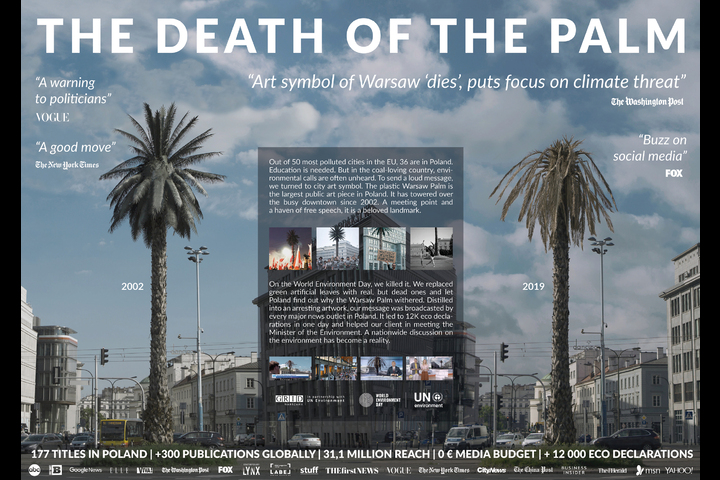
Thirty-six of the EU's 50 most polluted cities are in Poland, but the country's climate debate had split into bubbles that rarely heard each other. Warsaw has one symbol almost everyone knows: Joanna Rajkowska's artificial palm tree on the de Gaulle roundabout, green all year in a grey city. Overnight on 31 May 2019, the team, working with the artist and the Museum of Modern Art, replaced its plastic leaves with real, dead ones. The cause was kept secret for days, then revealed around World Environment Day as air pollution, with a call for eco-actions. The palm was restored to green on 14 June. A tree that could not die had died, and the message reached people, whatever news they read.
The Wildlife Impact Card — Mastercard, McCann, 2021
One million animal and plant species are at risk of extinction, but a forecast of extinction feels too distant to act on. Mastercard and Conservation International put the forecast on something people carry every day. Gift cards in the Wildlife Impact Card programme featured critically endangered species, such as the Sunda pangolin and the African forest elephant, that could be extinct by the time the card expired. One dollar from every card went to Conservation International, and holders could donate more to protect habitats. The expiry date is the least-read line on any card. Here, it became a deadline, and owners kept it in their wallets.
2. Let the Medium Deteriorate or Disappear
Make the medium lose, fade, break or vanish in the same way the consequence damages or removes something real.
Portraits by Predators — Forest & Bird, Colenso BBDO, 2019
New Zealand has more than 200 native bird species threatened by introduced predators, but attacks happen out of sight, so the threat stays abstract. Conservationists already monitor predators with edible cards that record which animals bite them. Colenso BBDO printed portraits of native birds on that card, scented them with bird pheromones and left them in the bush. The predators did the rest. They photographed the chewed remains and turned them into the outdoor campaign. Nobody illustrated the damage. The animals responsible did it themselves.
Life, Interrupted — UNFPA and UNICEF, Wunderman Thompson Portugal, 2023
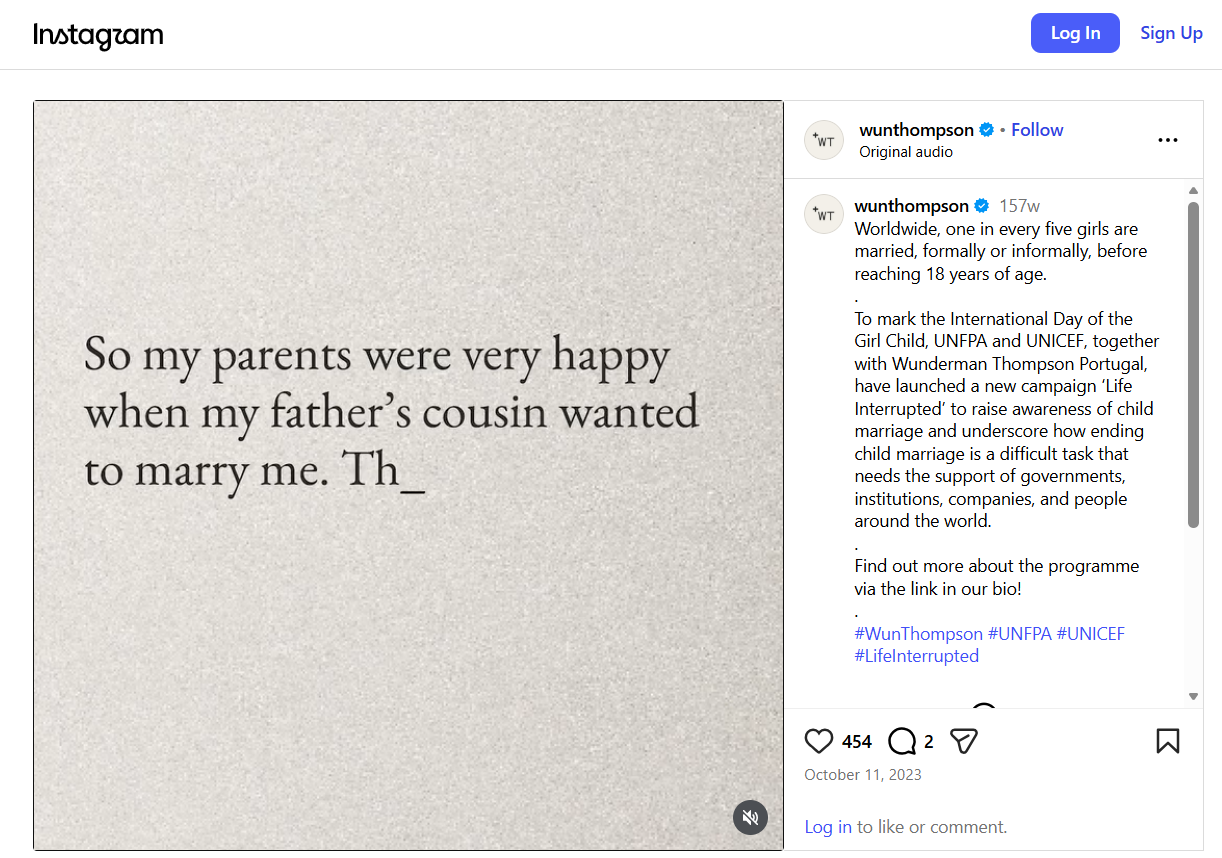
UNFPA and UNICEF needed governments, institutions, companies and the public behind their programme to end child marriage by 2030. The difficulty is that the statistic is huge and familiar: more than 12 million girls a year, a number so large it hides each future it cuts short. Wunderman Thompson Portugal wrote press ads and social posts telling the hopes and dreams of real girls from Yemen, Uganda and India. The text runs normally until the threat of marriage appears. Then the letters overlap, and the story falls apart. The layout does what the statistic cannot: it stops one particular story.
Summary
Each of these campaigns lets the medium show where a problem ends. When briefing this tactic, start with the consequence, not the problem. Then find a medium the audience already knows, trusts or loves, and ask what it would look like once that consequence arrives.