

Brands spend a long time fighting for shelf space in their own category and rightfully so. Yet the decision that leads to your product can often be made somewhere else — inside a different experience, at a moment your category hasn't thought to claim. The brands here didn't wait to be found. They moved.
Here are five tactics from the Commerce Engine that put the product in the aisle where the sale was already happening.
- Enter the Complementary Experience
- Follow the Object, Not the Aisle
- Let the Partner Reframe the Product
- Build Inside the Decision, Not the Category
- Move Into the Adjacent Format
1. Enter the Complementary Experience
Find the category where the same emotional need fires and get your product inside that moment.
Add the Look — eGo, Ogilvy Colombia, 2026
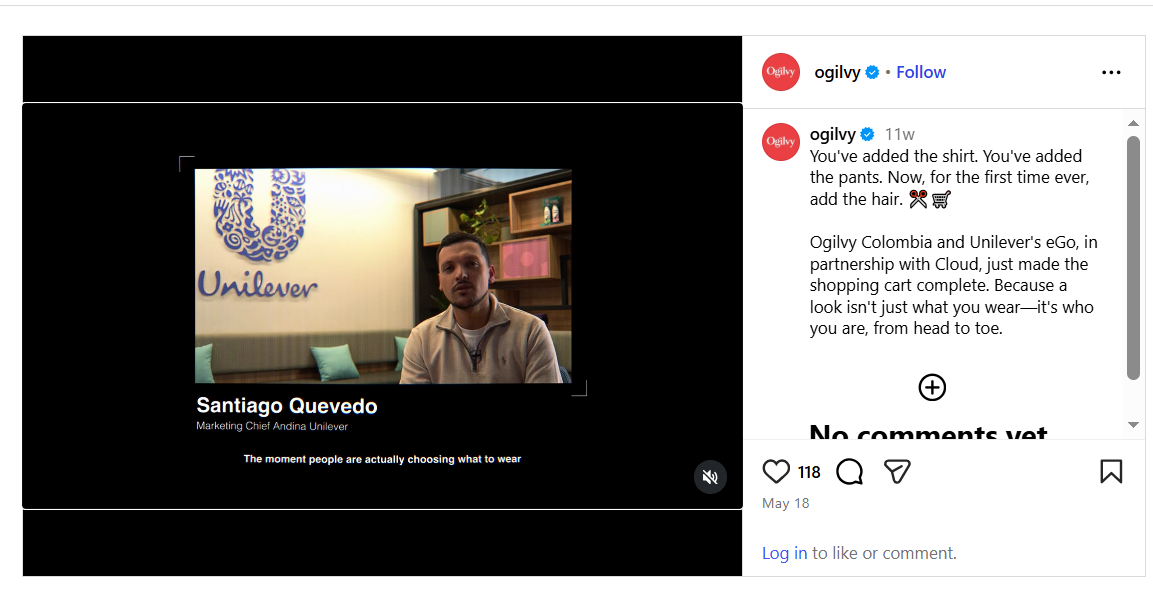
Hair care products sit on supermarket shelves, stripped of the context that makes them relevant. eGo, a Unilever-owned Colombian hair brand, put them somewhere else: inside a fashion retailer's checkout. Working with Cloud, a Colombian fashion brand, eGo added hairstyles to the online shopping experience — shoppers browsing Cloud's ecommerce platform could select a cut to complete their outfit and add it to their basket alongside the clothes. The booking was redeemable at Barber Brother, a barbershop chain, with eGo styling products addable to the same order ahead of the appointment. The campaign launched with Ogilvy Colombia and is now expanding across other fashion retailers in Colombia. Average order value increased by 99%. Ecommerce sales grew by 32%. Search-driven sales rose by 599%.
Häagen-Dazs partnered with MyTF1, France's largest VOD platform, to add an order button for ice cream delivery directly inside the viewing experience — available between 6pm and 11pm, when film viewership and consumption both peaked. Streaming platform Viu partnered with Deliveroo on an AI system that matched food delivery options to what characters were eating on screen, achieving 143% click-through rates in two weeks. Neither brand waited on their own shelf. Both found the moment where the adjacent need was already live.
2. Follow the Object, Not the Aisle
Get inside a physical object that travels through the relevant moment and build your brand experience through it.
Snickers Air — Snickers, Mediacom
Hunger is guaranteed on long-haul flights. Snickers partnered with China Eastern Airlines — one of China's largest domestic carriers — to own the problem at source. Passengers received edible boarding passes, a hunger safety announcement in the style of a flight safety briefing, and in-flight meals, all built around the 'You're Not You When You're Hungry' platform. The brand found an object — the flight — where hunger was structural and unavoidable, and built itself into the experience before the snack trolley got there.
Head & Shoulders placed a black branded filter inside the shared helmets of GrabBike, Vietnam's dominant ride-hailing service. When passengers removed the helmet at journey's end, a visible dandruff trace appeared on the filter. The helmet was mandatory. The removal moment was certain. No shampoo shelf could have done that.
3. Let the Partner Reframe the Product
Choose the right partner, and they change what your product means without you saying a word.
Diesel × Mustafa — Diesel, Publicis, 2018
Mustafa runs a kebab kiosk on a Berlin corner. He's also one of the city's most unlikely style icons, his shop a regular stop for the creative crowd that Diesel wanted to reach. The brand created a full fashion collection with him, parodying the conventions of high-end collaborations while earning the kind of cultural credibility those conventions usually fail to manufacture. The range sold out. Vogue covered it. Harper's Bazaar covered it. Diesel didn't buy its way into that conversation. It partnered its way in, through a man who already lived it.
Comfee, a home appliance brand entering Southeast Asia, partnered with Mixue — a tea and ice cream chain already embedded in regional street culture — around the shared territory of "coolness." The partnership activated across thousands of Mixue locations: drink a Mixue Lemon Mint within 45 seconds and win a Comfee inverter air conditioner. The product entered an emotional context a product launch couldn't have reached.
4. Build Inside the Decision, Not the Category
Find the decision that precedes your product and show up there instead.
IKEA Apartmenteka — IKEA, In3, 2023

Millions of Russians live in standardised small apartments with uncomfortable layouts — a housing problem, not a furniture problem. IKEA built an online library of interior designs specifically for these apartments, each linked to IKEA's ecommerce platform for one-click purchasing. The product didn't change. The entry point did. IKEA showed up inside the moment someone decided to make their space work, long before they'd started browsing furniture retailers.
Colgate created limited edition golden toothbrushes designed as Valentine's gifts, built around the recognised relationship milestone of leaving a toothbrush at a partner's place. An oral hygiene product entered the romance decision — the moment two people choose to formalise something — before the category was anywhere near the picture. The product is unchanged. The decision it inhabits is entirely new.
5. Move Into the Adjacent Format
Find the format your audience has stopped seeing — and rebuild it in the space where they're already paying attention.
Banner Ad Changeroom — The ICONIC, Dentsu Creative, Sydney, 2025
Banner ads see an average click-through rate of 0.05%. The ICONIC built one that people voluntarily walked into. In Sydney's York Street, a physical changeroom was built to the exact dimensions of a standard digital banner ad. Customers tried on looks from the season's latest drop, were filmed immediately, and streamed live as shoppable banner ads on Vogue, news.com.au, and other major Australian publications. The streams ran simultaneously on digital OOH billboards in Martin Place. The most-clicked looks became outdoor executions. The format didn't change — it moved. Off the screen, into the street, into a context where a 0.05% click-through rate was no longer the ceiling.
The One Rule
Find the aisle where the decision lives. That's your shelf.
Want Your AI to Think This Way?
These tactics come from the Commerce Engine, one of a growing library of Thinking Engines built to make your AI more creative. Upload it to ChatGPT, Claude or Gemini and give your AI the campaign logic it needs to explore unexpected territories, reframe briefs, generate stronger ideas and pressure-test the ones worth pursuing.