
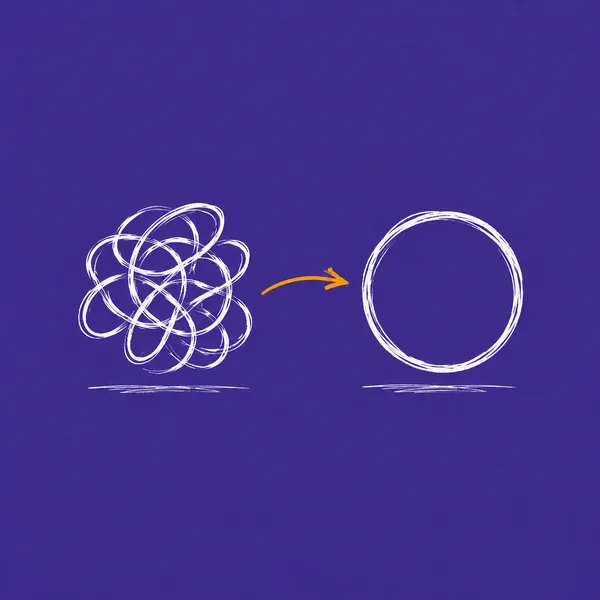
Most complex things aren't genuinely complicated — they're just badly translated. The jargon is someone else's shorthand. The data is someone else's spreadsheet. The legal clause is someone else's protection. The product is solving a problem people didn't know they had. The fix isn't simplification. It's finding the one frame, the one analogy, the one gesture that makes the audience think: I already understood that. Here are seven creative tactics that make the complicated feel completely obvious.
- Translate the jargon into human language
- Make the data feel like something real
- Turn the education into entertainment
- Use a single object to dramatise the contrast
- Use cultural insight to unlock simplicity
- Let the product prove it by doing it
- Tackle the complexity nobody wants to name
1. Translate the Jargon Into Human Language
Take the language that excludes people — and convert it into something they already understand.
The Contract Translator — Reclame Aqui, Grey Brazil, 2022
Reclame Aqui is Brazil's biggest consumer complaints platform. Their audience's core problem: dense legal contracts loaded with hidden risks that most people sign without understanding. Grey Brazil built an AI-powered app using neural networks trained on over 500,000 legal terms — capable of converting contract small print into plain language and flagging hidden risks in real time. The tool rolled out to 800,000 users, with a high satisfaction rate on launch. The brand didn't explain consumer protection. It demonstrated it in the most literal possible way: by doing the translation live, in the user's hands.
mycar Tyre & Auto's Auto-Translate (TBWA, 2023) built a real-time online tool that converted mechanic-speak into plain, often funny human analogies — drawing on Google search data to identify the most confusing automotive terms. CoinFlip's "Normal People Use Crypto" (Quality Meats, 2023) used humour and relatable everyday personas to reframe cryptocurrency from elite-tech territory to something normal people could use on the Olliv platform, successfully repositioning the brand from intimidating to accessible.
2. Make the Data Feel Like Something Real
Find the number that means nothing as a statistic — and make it mean something as an experience.
Unhide the Price - Sparkassen, Jung von Matt, 2024
Sparkassen made invisible financial data tangible for young German gamers — building a browser extension and AR app that converted in-game skin purchases back into Euros in real time, making the true cost of digital overspending impossible to ignore.
Aviva's Make It Click (adam&eveDDB, 2023) translated abstract financial planning into the tactile metaphor of puzzle-solving — the campaign showed life's financial challenges as problems with a last piece missing, driving national rollout and brand warmth uplift.
3. Turn the Education Into Entertainment
Make the learning so good that nobody notices they're being taught.
HACKED — Sallie Mae, GYK Antler, 2022
Sallie Mae needed to reach Gen Z students on financial aid — a topic that typically produces the glazed expression of someone being briefed on pension options at 22. GYK Antler created HACKED: a stylised, game-like YouTube series covering FAFSA applications, scholarships, and financial planning, built with the visual language of video games rather than financial services. The series generated 12.9 million views with a 63% view rate and a measurable uplift in Net Promoter Score. The content worked because the format promised entertainment and delivered education — not the other way around.
Dutchie's Love Your Gut (Ogilvy Thailand, 2022) used the metaphor of a failed delivery to explain what happens when the gut can't absorb nutrients — turning an invisible biological process into a relatable, funny everyday scenario that reached 4 million people and overperformed on KPIs by 94%. Corridos Legal Radio (Southern Poverty Law Center, 2020) wrote folk songs containing legal rights advice for immigrant workers in US border states who only access media via radio — turning civil rights information into oral culture, reaching communities that no brochure could.