

Getting to an idea worth fighting for rarely begins from an obvious starting point. Inspired by former Wieden+Kennedy Creative Director Jason Bagley, this series uses provocative questions to mine the Big Ideas That Work Engines for repeatable creative tactics that can help answer them.
This time, we’re asking:
How could people use the product completely wrong?
Here are seven campaigns that probably weren't thought of by asking this question and a few others, but they could have been...
- Combine It With the Wrong Thing
- Give It a Completely Different Job
- Encourage People to Misuse the Product Tool
- Put It Inside the Wrong Profession
- Celebrate the Accidental Result
- Design Merchandise That Enables the Misuse
- Make the Brand Interface Do the Wrong Job
1. Combine It With the Wrong Thing
Most food brands work hard to make their serving suggestions look appetising. Weetabix chose baked beans.
Weetabix and Baked Beans — Weetabix, Frank PR, 2021
The brand posted an image of Heinz beans poured over two Weetabix biscuits without explanation. The combination looked culturally, texturally and possibly morally wrong.
That wrongness became the media plan.
People rushed to condemn it. Brands, public institutions and emergency services joined the argument. A simple social post became national news because the audience could not resist expressing an opinion.
The idea worked because the combination was not merely strange. Both products were deeply familiar British staples that appeared perfectly reasonable on their own. Putting them together violated an unwritten rule everyone instantly understood. The product demonstration became a provocation.
The question that could have produced it:
What is the most offensively wrong thing we could combine with the product?
The creative move: The Worst Combination, from the Dumb Thinking Engine
2. Give It a Completely Different Job
Preserve the product’s relevance by finding a use for it unrelated to its intended role.
DIY January, Tito’s Vodka, 2023
Dry January presents alcohol brands with a fairly fundamental problem: people are encouraged not to use the product at all. Tito’s responded by asking Martha Stewart to demonstrate alternative household uses for vodka, including cleaning surfaces, deodorising boots and preserving flowers. The product was no longer a drink. It became a suspiciously versatile DIY supply. By using vodka improperly, Tito’s stayed useful and visible during a cultural moment that normally excludes the category, while keeping its product at the centre of the joke.
The question that could have produced it:
If people are not going to consume the product, what else could they do with it?
The creative move: Turn a Cultural Restriction Into a Satirical Product Benefit, from the Parody Engine
3. Encourage People to Misuse the Product Tool
Find the unintended behaviour already happening around a brand tool and elevate it into something official.
Soffa Sans, IKEA, Proximity London, 2020
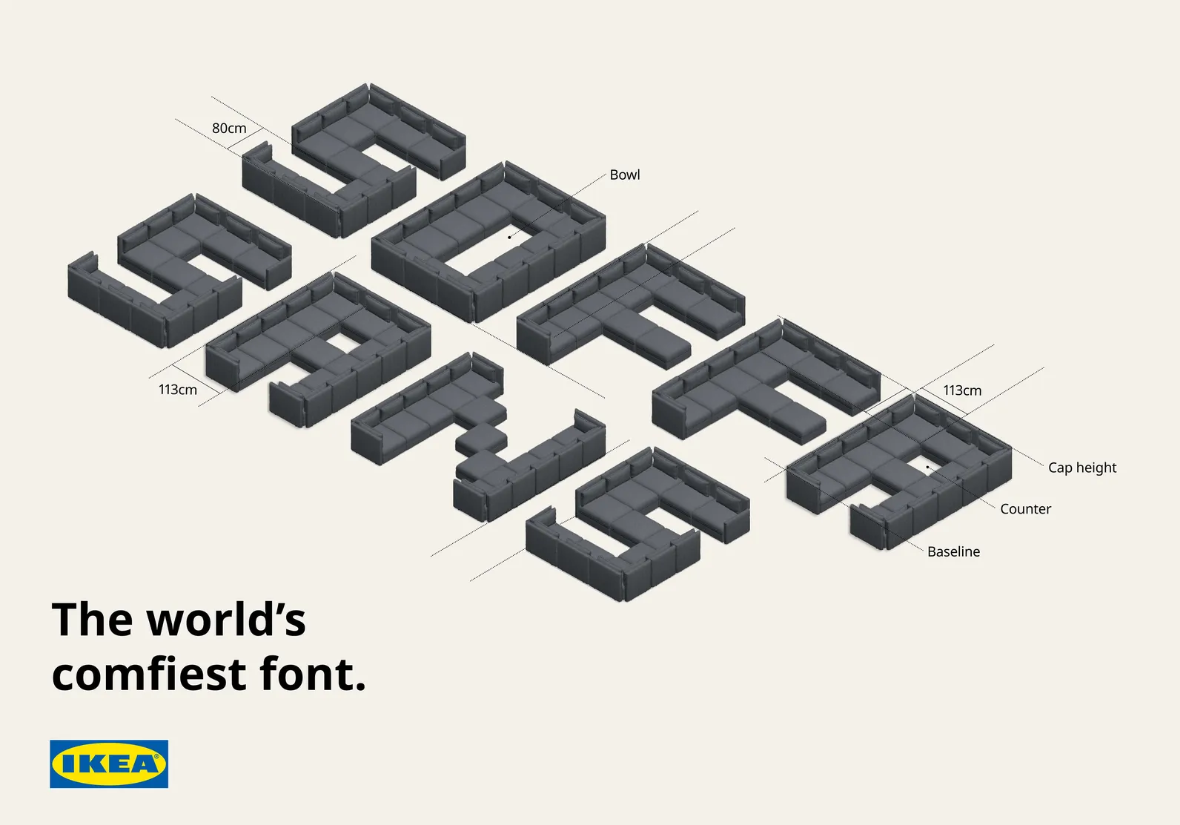
IKEA’s online sofa planner was designed to help people configure furniture that might conceivably belong in a living room.
Some users had other ideas.
They used the planner to build spirals, labyrinths, letters and abstract shapes rather than sensible sofas. IKEA could have treated these creations as irrelevant misuse. Instead, it studied them.
The brand converted 38 of the unconventional configurations into glyphs for Soffa Sans, a downloadable typeface made entirely from sofas. An underused planning tool became a playground, while users’ mischief became an official piece of IKEA design.
The move worked because IKEA did not invent a new participatory behaviour and ask people to adopt it. It recognised that people were already playing with the tool and validated their creativity. Improper use became evidence that the experience was more interesting than its designers had realised.
The question that could have produced it:
How are people already using our tool in ways its designers never intended?
The creative move: Embrace Bad Behaviour, from the Dumb Thinking Engine