

Debate-led campaigns pick a point of tension — a norm, a phrase, a cultural habit, an institutional absurdity — and make the brand or the cause the thing that forces it into the open. Here are eight tactics designed to bait you.
- Divide the Nation
- Hijack a Norm
- Reclaim the Phrase
- Verbal Ambush
- Fictional Authority
- Use Culture as a Mirror
- Make Unfairness Physically Felt
- Turn Policy Into Provocation
1. Divide the Nation
Force a binary choice — and let the audience fight it out.
Walkers — #CrispIN or #CrispOUT
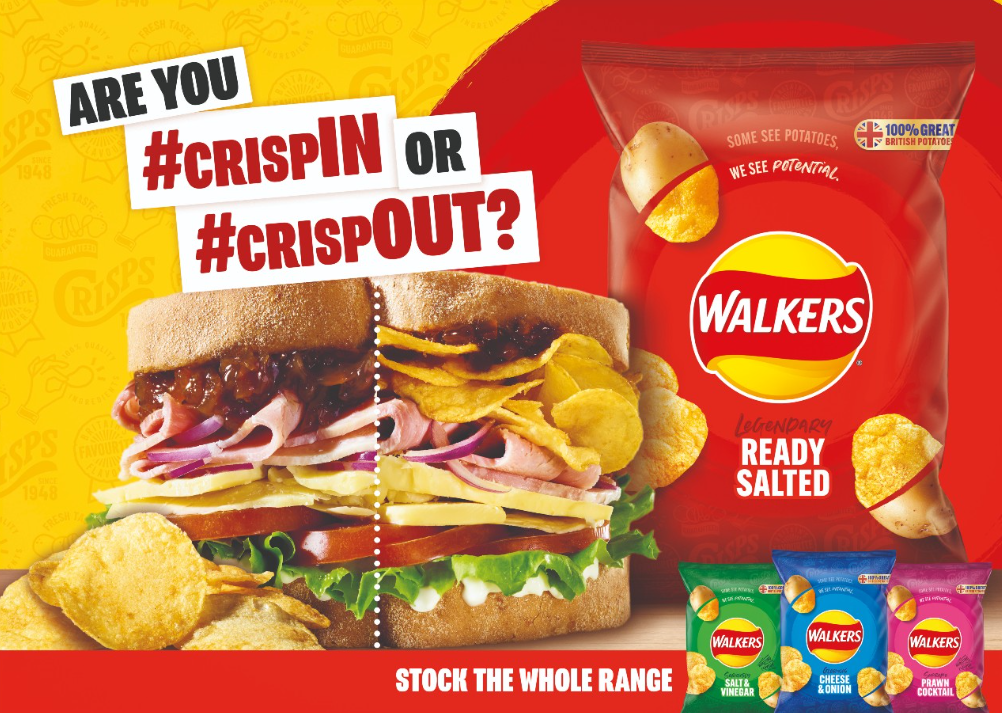
Walkers revived a question the British public had apparently been suppressing for decades: do crisps belong inside a sandwich? The campaign didn't try to answer it. It handed the question to the nation and watched the sides form. The playfulness of the stakes made public commitment easier — nobody felt they were risking anything by going loud on their crisp position — but the engagement numbers were serious.
Paddy Power's "Nobody Does Football Better Than Us" ran the same binary at national-identity temperature — England vs American sporting culture, Danny Dyer vs Rob Lowe — with the World Cup hosted on US soil as the trigger. The brand didn't pick a side. The pronoun in the title did it for them. KitKat asked whether you bite or snap. Oscar Mayer ran mock-serious hotdog debates about grilling versus boiling. While McDonald's Nordics — Pickle It Forward (Nord Copenhagen, 2026) turned the longstanding pickle divide into a shared economy. Haters could donate unwanted pickles to a digital bank; lovers could claim up to four free. Real-time data showed which cities were donating and which were raiding. The debate was already there — TikTok had been amplifying pickle culture for years
2. Hijack a Norm
Challenge an accepted tradition — then make the challenge impossible to ignore.
Vienna Tourist Board — Vienna Strips on OnlyFans (Jung von Matt DONAU, 2022)
Instagram's algorithm kept flagging Viennese museum art — Schiele, Klimt, canonical works — as sexually explicit content. The Vienna Tourist Board's response was to publish the same art on adult entertainment site OnlyFans. The stunt forced a simple question into global circulation: if OnlyFans has more editorial tolerance for Schiele than Instagram, who is actually protecting culture? Jung von Matt DONAU reported over 2.5 billion impressions and 730 million worldwide reach.
Heinz petitioned to end Roman numerals for Super Bowl events — a tongue-in-cheek challenge to a sports tradition nobody had thought to question. NFL x Tide asked Americans to move laundry day from Sunday to make room for football. Aldi turned a legal dispute over lookalike cakes into a meme war — the Free Cuthbert campaign reframed a cease-and-desist as an act of rebellion. Absurd Promises (ASDRA / VML Argentina, 2024) hijacked Argentina's presidential debate culture to force a single question: why do people with Down syndrome have to renew a certificate for a permanent genetic condition?