



Audiences have pattern-matched their way to immunity. They know what a brand film looks like, what a social experiment smells like, what a cause campaign sounds like. The skip reflex kicks in before you’ve even made your case. Fake Format Reveal breaks that reflex by turning up dressed as something else: a brutal job listing, a national news story, a soap opera, a press release about a beloved childhood snack. The message only lands once the audience is already through the door. Here are seven Trojan Horse tactics from the Creative Tactics Engine designed to keep the door open.
- Fake the job ad — then reveal who actually does it
- Fake the product — then reveal what it’s really selling
- Fake the entertainment — then reveal the crisis it was based on
- Fake the news — then let the outrage prove your point
- Fake the offer — then catch the audience in their own behaviour
- Fake the ad — then let the kids who can’t read write it
- Fake the influencer — then reveal what she was hiding all along
1. Fake the job ad
Post the world's most ludicrous job — and let the interview reveal the truth.
World's Toughest Job — American Greetings, 2014
American Greetings posted a real-looking job ad for a demanding, unpaid role: no breaks, no holidays, constant availability, physically and emotionally exhausting. Real candidates applied. Real interviews were filmed. Their shock — "that's not legal," "no one would do that job" — was captured on camera. Then the reveal: the job was motherhood. Viral empathy. Widespread sharing. A card company earned a cultural moment by burying the product entirely until the last ten seconds.
The format worked because the candidates' disbelief did the arguing. No voiceover needed. No brand claims. Just real people arriving at the same conclusion the brand wanted — through their own reaction.
2. Fake the product — then reveal what it's really selling
Launch an absurd product that doesn't exist — to expose the problem with the ones that do.
Sparkasse Self-Help Books — Sparkasse
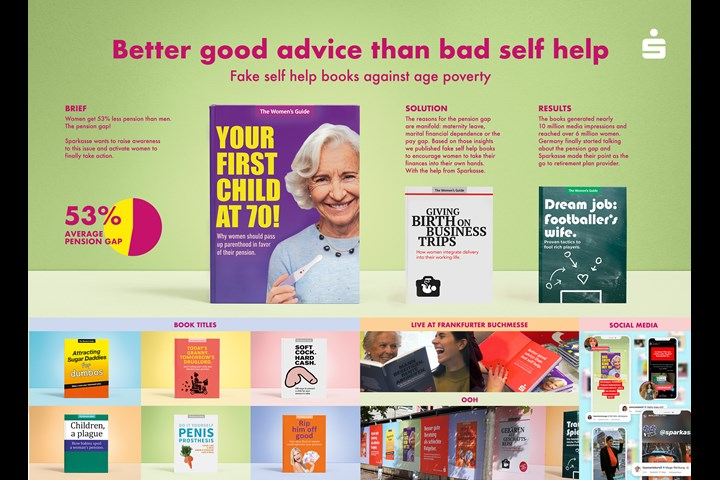
To make Germany pay attention to women’s pension poverty, Sparkasse and Jung von Matt launched a series of fake self-help books with provocatively absurd titles. Introduced at the Frankfurt Book Fair and amplified through Sparkasse’s social channels and partner media, the books mocked the patronising “advice” women are often implicitly given about financial insecurity. The campaign then made its point explicit: the joke wasn’t the books, but the social logic behind them. It turned a dry, statistically familiar issue — Germany’s gender pension gap — into something visible, public and hard to ignore.
The fake product gave the problem an absurd physical form that suckered attention and kept it.