

Most briefs arrive downstream. They describe the behaviour people can see, the complaint customers make, or the damage already done. Then they ask the marketing team to improve it.
Upstream thinking starts somewhere else. What is producing the problem? Is there a rule blocking access? An ingredient creating harm? A product that relies on people remembering what to do? Infrastructure that exists but cannot be reached? An incentive rewarding the wrong behaviour?
Here are seven ways brands can remove barriers, alter inputs, prevent harm, recover waste, release capacity, change incentives and redesign the conditions producing the issue.
The seven sub-tactics
- Remove the Structural Blocker
- Change What Goes In
- Build Prevention Into the Product
- Turn the Output Back Into an Input
- Unlock the Capacity That Already Exists
- Change the Incentive at Source
- Rebuild the Environment Producing the Problem
1. Remove the Structural Blocker
Find the rule, requirement or missing step that makes the better outcome impossible.
No Fixed Address — HSBC UK and Shelter, 2019
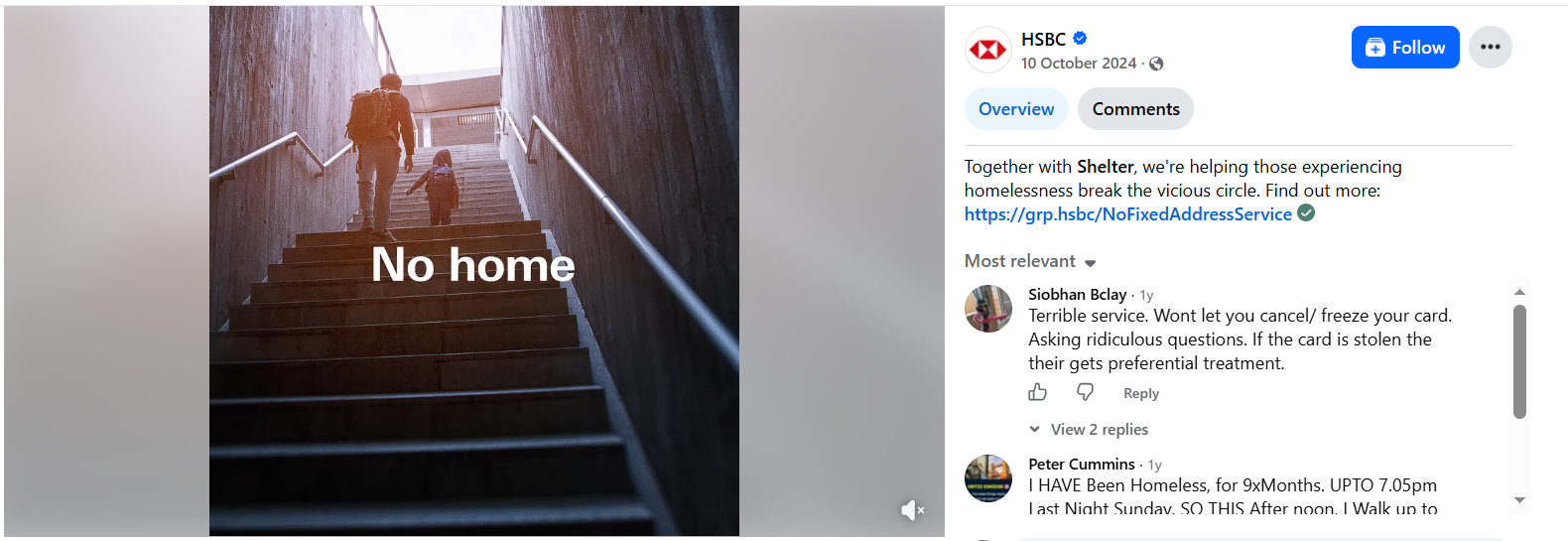
For someone experiencing homelessness, opening a bank account can be a route back into work and housing. It can also be impossible. Banks traditionally ask applicants for identification and proof of address—the very documents someone without a secure home may not possess.
HSBC UK and Shelter worked on overcoming this obstacle. Through the No Fixed Address service, people experiencing homelessness or housing difficulties can be referred by an approved charity. A caseworker helps arrange an appointment at a participating HSBC branch, allowing the applicant to open a basic account without conventional proof of address.
The intervention matters because the problem was never a lack of enthusiasm for banking. It was a system that demanded evidence of stability before giving people access to one of the tools needed to regain it. HSBC says the service has helped more than 6,000 people open accounts.
2. Change What Goes In
Alter the ingredient, material or information entering the system before it creates the harmful output.
The Cow’s Menu — Burger King, DAVID Miami, 2020
Beef has a methane problem. Burger King could have encouraged customers to offset their meals, choose a different product or feel slightly worse about ordering a Whopper. Instead, it looked further back in the supply chain: at what the cattle were eating.
Working with researchers, Burger King tested adding dried lemongrass leaves to cattle feed. Its research suggested that the formula could reduce methane emissions by up to 33% on average during the final three to four months of the animals’ lives.
The qualification matters. This was a limited feeding intervention, not a claim that every Burger King cow suddenly produced one-third less methane across its lifetime. The scientific and environmental case required more work. But the creative move was sound: if digestion produces the emission, change what is being digested.
Burger King then made the research public in the hope that other producers could develop it further.
3. Build Prevention Into the Product
Make the product, packaging or service stop the problem without relying on people to remember.
The Killer Pack — Maxx Flash, VMLY&R Mumbai, 2022
Mosquito coils protect people inside the home. The discarded packaging usually does nothing. In some places, it can end up in rubbish sites and stagnant water—the same environments in which mosquitoes breed.
Maxx Flash turned the pack into a second form of protection. The biodegradable packaging was treated with Bacillus thuringiensis, a biological agent used against mosquito larvae. Once discarded in breeding environments, the pack was designed to help kill larvae before they became adult mosquitoes.
The product attacked mosquitoes indoors. The pack addressed them outside. Disposal was no longer the end of the product’s function.
Savlon’s ID Guard applied similar thinking to handwashing. It incorporated a multi-use handwash sachet into the identity cards worn by schoolchildren in India. The hygiene product travelled with the child rather than waiting beside a sink that might not be nearby.
Sapolio’s Guardian Toad moved prevention into stored household water. Designed for Peruvian communities where water is kept in containers, the small solar-powered prototype kept the surface moving so mosquitoes could not easily lay their eggs. It was still at the scaling stage when publicised, but the upstream logic was clear.