

Most advertising fights for attention. These campaigns don't. They find a moment that already exists — a shopper browsing, a viewer craving what's on screen, a driver stuck in traffic — and make the offer feel like the most logical thing. Here are seven tactics that got inside the moment.
- The Mirror Moment Intercept
- The Live Screen Trigger
- The Hunger Intercept
- The Everyday Object
- The Emotional State Intercept
- The Right Place at the Right Second
- The Anti-Purchase
1. The Mirror Moment Intercept
Find the shopping moment when someone imagines a version of themselves, and put your product in that moment for consideration.
Add the Look — eGo, Ogilvy Colombia, 2026
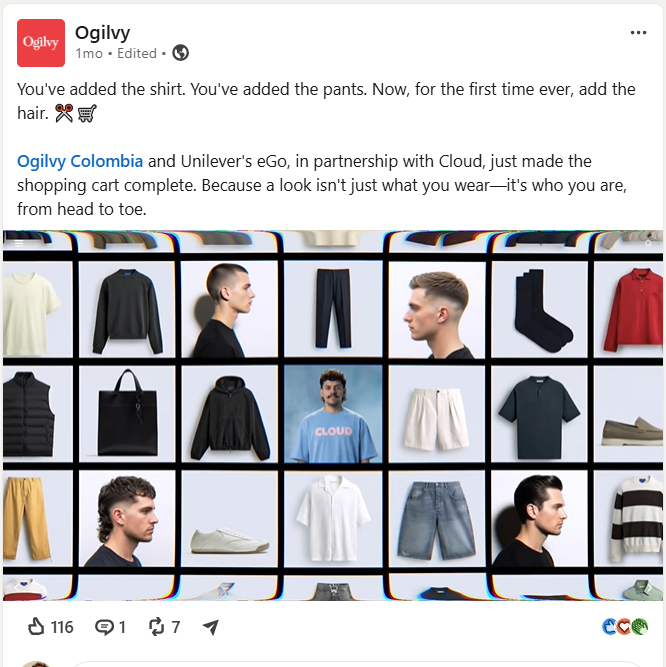
Hair care products sit on supermarket shelves, stripped of the context that makes them relevant. eGo, a Unilever-owned Colombian hair brand, found where that context actually lives: a fashion retailer's checkout. Working with Cloud, a Colombian fashion brand, eGo added hairstyles to the online shopping experience — shoppers browsing Cloud's e-commerce platform could select a cut to complete their outfit and add it to their basket alongside the clothes. The booking was redeemable at Barber Brother, a Colombian barbershop chain, and shoppers could add eGo styling products to the same order ahead of the appointment. Created with Ogilvy Colombia, the campaign entered the moment consumers were deciding on 'their look'. Average order value increased by 99%. Ecommerce sales grew by 32%. Search-driven sales rose by 599%. eGo is now expanding the mechanic across other Colombian fashion retailers.
2. The Live Screen Trigger
Something on screen fires a contextual, scannable deal the instant it appears. The broadcast moment is the offer.
Handshake Hunt — Mercado Livre, GUT São Paulo, 2023
On Black Friday, Mercado Livre didn't buy commercial breaks on Globo. GUT used AI to pre-analyse thousands of scripts and map every handshake scene across an entire day of broadcasting. When a handshake appeared on screen, a QR code fired in the corner, linking to a contextualised deal—handshakes in music shows unlocked instrument discounts; movie handshakes unlocked TV deals. The trigger was Mercado Livre's own logo. 39% year-on-year sales growth overall. 80% growth on Black Friday itself. 7.8 billion impressions. 50 million coupons issued.
OREO turned referee jerseys — black-and-white stripes — into shoppable moments during March Madness. Viewers pointed their phones at an on-screen referee to unlock Walmart offers in real time. 100,000 live scans. 61% redemption rate. 9.8% direct sales increase. No ad spend inside March Madness's notoriously expensive broadcast slots. Brahma went further: sponsored athletes delivered discount codes verbally during on-pitch conversations caught by broadcast cameras. Fans who lip-read the codes unlocked exclusive offers. The athlete's mouth was the storefront. The broadcast camera was the medium.