

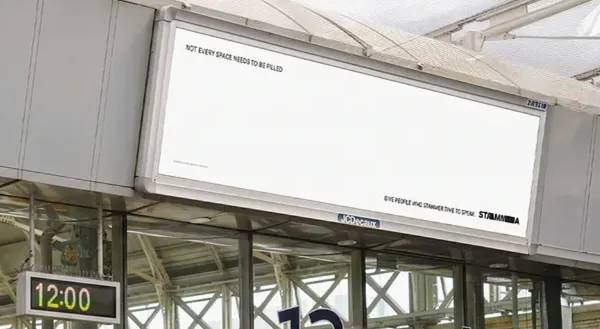
STAMMA · Iris London · June 2026
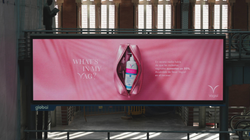
STAMMA’s Leave Space campaign uses empty advertising space to demonstrate what people who stammer need from a conversation.
The outdoor executions contain little more than two lines: “Not every space needs to be filled” and “Give people who stammer time to speak.” The rest of each billboard remains conspicuously blank.
In a busy media environment, that emptiness is difficult to ignore. It also recreates the moment the campaign wants its audience to reconsider. When someone pauses while speaking, other people can become uncomfortable and rush to complete the sentence, interrupt or end the interaction. For someone who stammers, the pause is not empty. It is part of speaking.
The campaign launched across cities including Manchester and Liverpool using pro bono JCDecaux media. The work was informed by STAMMA research finding that 14% of people who stammer were hung up on during their most recent call to an organisation.
The Tactics Behind the Work
Iris London may not have called them this. But these are the repeatable Metaphor Engine tactics behind the work.
Media Metaphors: Let the Format Do the Arguing
Let the Format Do the Arguing builds the message into the behaviour of the medium. Instead of merely carrying the claim, the advertising format becomes evidence for it.
Advertising normally treats unused space as waste. Everyday conversation can treat silence in much the same way. STAMMA connects the two behaviours, using the compulsion to fill a billboard as a metaphor for the compulsion to fill a pause.
The blank area is not merely a visual style or an attention device. It performs the patience the campaign is asking people to practise.
Audi’s The Cropped Car cropped the car almost entirely out of its own advertising, using the missing vehicle to draw attention to the safe passing distance motorists owe cyclists. IKEA’s Ads That Skip You featured organised protagonists apparently skipping its six-second pre-rolls for the viewer, turning the format into a demonstration of time-saving organisation. In both cases, the medium performs the message rather than merely carrying it.
Leave Space applies that logic to behaviour change. The billboard gives the audience room, then asks them to give the same room to someone else.
Absence-as-Metaphor
Absence-as-Metaphor removes something we expect to encounter so that its disappearance becomes the message.
Here, the missing element is advertising itself. Headlines, images, supporting arguments and calls to action are stripped away. What remains is an expanse of space that initially appears unused but gradually reveals its purpose.
NHS Blood and Transplant’s Missing Type removed the letters A, B and O from familiar names to make a shortage visible. Heineken’s Shutter Ads used closed bar shutters as both advertising space and symbols of the venues that culture was losing. Both campaigns make an absent element more noticeable than a present one.
STAMMA does something subtler. It turns the absence of communication into a more considerate form of communication. The billboard appears unfinished because the conversation should be allowed to remain unfinished until the speaker is ready. The result turns inclusion from representation into accommodation.
The Question That Could Get You Here
How could our communication physically behave in the way we want the audience to behave?