

Giving someone a product for free does not guarantee they will notice, use or remember it. The strongest trial campaigns give people a reason to care about what happens next. They turn trying into a test, a diagnosis, a discovery, a reward, or a revealing comparison. The distribution may still matter, but the strategic idea sits in what the consumer must do, experience or learn once the product reaches them.
- Compress Paid Content into a Teaser
- Create a Constraint That Expresses the Proposition
- Create the Problem the Sample Solves
- Diagnose Product Compatibility
- Find the Trial Reward Inside an Existing Purchase
- Intercept Inferior Content with a Legitimate Trial
- Make Taking the Sample Demonstrate the Benefit
- Make the Product a Mystery
- Make the Sample Instantly Functional
- Use Identity as Trial Eligibility
1. Compress Paid Content into a Teaser
Condense the product experience without stripping away the distinctive value that makes people want more.
Raising Eyebrows and Subscriptions — The Economist, Proximity, 2015
The Economist needed to reach time-poor prospects who assumed its articles demanded more attention than they could spare. It placed ten-second summaries on selected websites, presenting each article one word at a time before inviting readers to continue to the full piece. The format did not merely advertise the journalism. It provided a compressed experience of its intelligence and relevance. By answering the time objection through the trial itself, the campaign reportedly generated £1.7 million in revenue and a 10:1 return.
2. Create a Constraint That Expresses the Proposition
Attach a rule to free access that makes participating in the trial part of the brand argument.
#HandsOff — Marc Dorcel, Marcel Paris, 2015
Marc Dorcel had to overcome a valid consumer objection. Why should viewers pay for professionally produced adult content when there is so much material freely available online? To meet this objection head-on, the brand temporarily opened its premium library, but with one condition: viewers had to keep both hands on designated keyboard keys. Removing either hand stopped the film. The mischievous constraint allowed people to see the difference in quality while preserving a rather important reason to subscribe. Trial was available, but deliberately not in the form people ultimately wanted to use. The campaign reportedly multiplied site traffic by 27 and subscriptions by 50
3. Create the Problem the Sample Solves
Give people a safe, immediate problem so they can prove the product works by solving it themselves.
Breaking News — Henkel Super Bonder, Ogilvy, 2016
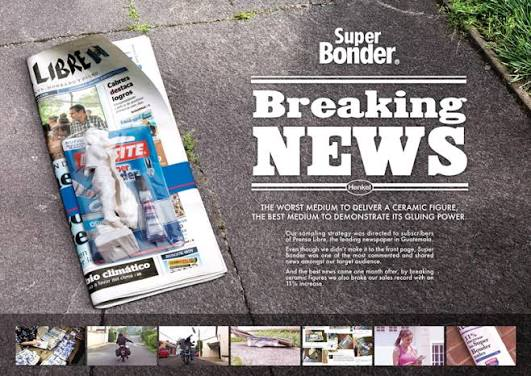
Super Bonder wanted to make the strength of its adhesive personally credible rather than merely claimed in an advert. Ogilvy distributed fragile ceramic figures with newspapers, knowing the objects would break in transit. Each arrived with a Super Bonder sample so the recipient could repair the damage. The distribution system deliberately created the exact problem the product was designed to solve. Instead of receiving a sample they might store and forget, consumers received an immediate reason to test it and reportedly helped drive a 15% sales increase.
4. Diagnose Product Compatibility
Turn trial into a personal investigation that promises to reveal whether the product is right for you.
The Gene Project — Marmite, adam&eveDDB, 2018
Marmite’s love-it-or-hate-it reputation was already famous, but familiarity had made the debate predictable. The Gene Project invited people to take a test that supposedly revealed whether they were genetically predisposed to love or hate the spread. The scientific premise was playful rather than medically consequential, but it gave people a fresh personal question that only tasting could settle. Trial became a form of self-diagnosis, while every result provided another reason to discuss the brand’s defining polarisation. The campaign reportedly increased sales by 14%.
5. Find the Trial Reward Inside an Existing Purchase
Use a product people already buy to unlock trial of one they do not yet associate with the brand.
Prize on the Bone — KFC, DM9 São Paulo, 2025
KFC possessed enormous chicken equity in Brazil but little recognition for its ice cream. Rather than promoting the unfamiliar category separately, the brand printed “You won an ice cream” on 3,000 drum bones hidden inside chicken buckets. The reveal borrowed the nostalgic pleasure of finding a prize on an ice-lolly stick, but placed it inside KFC’s best-known product. Existing purchasing behaviour became the route into a new category, making the trial feel discovered and earned rather than pushed through an indiscriminate giveaway.