

CLIF Bar · Ogilvy UK & Ogilvy SocialLab · April 2026
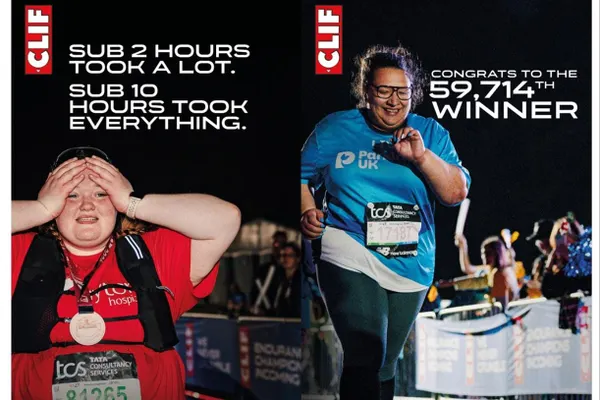
CLIF Bar launched Final Finishers on the day of the 2026 TCS London Marathon — an OOH and social campaign that put the slowest finishers at the centre of its creative. Many had been running for over eight hours. The taglines treated the math as the message: "First place took 1:59. Last place took everything." and "Congrats to the 56,714th winner."
In a first for the race, CLIF Bar took over the secondary finish line in St James's Park, creating an experiential cheer zone for the final runners on the home stretch with press interviews staged at the finish line to drive earned coverage.
The campaign positions CLIF Bar, an established US energy brand, as a brand of choice for UK athletes of all abilities.
The Tactics Behind The Work
Ogilvy UK may not have briefed these ideas in these terms. But the tactics below are repeatable patterns — each one used across hundreds of campaigns — that describe the same strategic logic this work is built on.
1.Reframe Who the Hero Is
Sports marketing defaults to the fastest. CLIF Bar reframed the lead role without arguing against that hierarchy — it just pointed the camera somewhere else. The high-editorial photography is the mechanism: the same visual language used for elite athletes, applied without irony to runners who took eight hours.
2. Expose the Absurdity of the Current Norm
"First place took 1:59. Last place took everything." doesn't claim the current norm is wrong. It just makes the norm — that the fastest finisher deserves the coverage — suddenly looks less like an obvious truth.
3. Claim the Unsponsored Moment
The secondary finish line in St James's Park was unowned — not because it lacked emotional weight, but because no brand had worked out what to do with it. CLIF Bar turned it into a cheer zone, making the brand physically present in the moment it was rhetorically claiming. Sponsoring the race gets a logo on a barrier. Owning this finish line got them a story.
How Could You Have Got Here?
These are the questions that could have helped you arrive at this idea.
— Who does our category celebrate by default — and who does it quietly ignore in doing so?
— Is there a finish line, a completion moment, or an achievement in our space that most people experience and nobody brands?
— If we took our category's most prestigious visual language and applied it to the least expected subject, what would that image say?
— Where does the official narrative of this event end — and where does the real human experience begin?
— What would it cost us to show up at the moment the spectators go home?
— Can we make the brand's argument with a number rather than a claim?
Want Your AI to Think Like This?
Questions like these are part of our prompt packs, which interrogate a brief every which way, and are included in a paid membership to this platform. Upload them to Claude — or whichever AI you use — and start generating genuinely interesting creative territories on your next brief in minutes.