

Embrace Second Place

Five ways to concede the top spot but keep the argument.
Embrace Second Place

Every brand brief seems to contain the same gravitational pull: be number one, be the best, be the most important, command the most attention. Which is exactly why deliberately giving up first place can be so powerful.

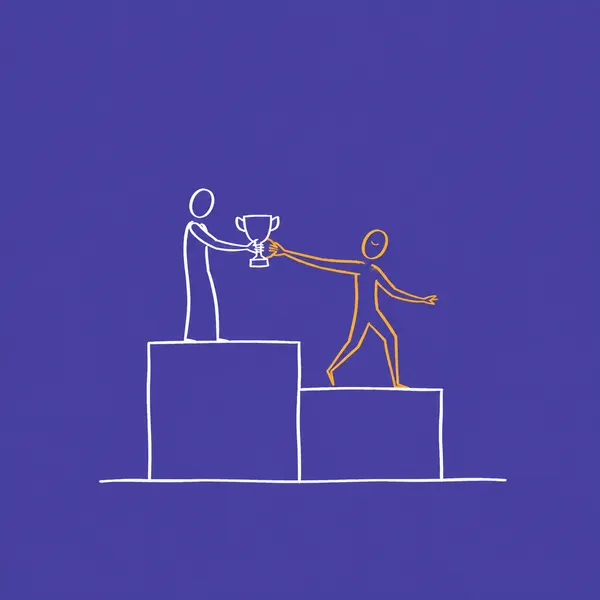
Embrace Second Place turns a concession into the source of brand strength. Instead of pretending to be first, best, biggest or most important, the brand willingly gives something up - rank, product dominance, celebrity status, importance or cultural attention - and makes that sacrifice carry the argument.

Here are five ways campaigns have made coming second work harder than claiming first.

  1. Concede Your Importance
  2. Confess the Rank
  3. Lose on Purpose
  4. Demote the Icon
  5. Concede the Moment

1. Concede Your Importance

Make the brand deliberately secondary to the thing it exists to enable.

Your Second Most Important Network - Tesco Mobile · BBH London · 2026

Telecommunications advertising habitually makes the network the hero: coverage, speed, technology, connectivity. Tesco Mobile changed the hierarchy.

Its proposition, "Your Second Most Important Network", places people's actual network of family, friends and communities first. Tesco Mobile is valuable precisely because it connects people to something more valuable than Tesco Mobile. The concession therefore sharpens the product's purpose rather than diminishing it. The technology becomes the enabler, not the destination.

Get Busy Living - Monzo · BBH London · 2026 makes a closely related concession. Banks normally fight for customers' attention. Monzo deliberately gives some of that attention away. Across ten single-shot films, life occupies the foreground while the bank's features operate quietly around the edges. Good banking, the campaign suggests, should free you to think about banking less.


2. Confess the Rank

Name your own inferior position out loud and let the honesty do the persuading.

We Try Harder - Avis · DDB · 1962
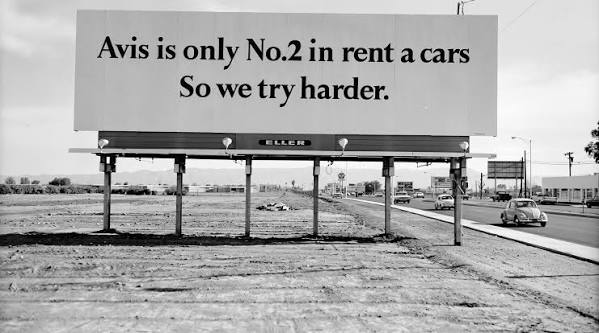
Avis was trailing Hertz when it made its number-two status the premise of its advertising: if you are not the market leader, you have to try harder.

Rather than disguise the weakness, the campaign converted it into behavioural proof. Avis could not afford dirty cars, bad service or making customers wait. The concession also quietly reframed Hertz: if Avis had to try harder, perhaps the leader could afford not to.

The results made it one of advertising's definitive challenger platforms. Within a year Avis was profitable for the first time in a decade, and between 1963 and 1966 the Hertz-Avis market-share gap narrowed from 61-29 to 49-36.

The Other Hardware Store - Mitre 10 · Dig · 2022 uses the same move more gently. As Australia's second-largest hardware network but rarely the automatic first thought, Mitre 10 simply admitted it was "the other hardware store". Being overlooked became the reason to reconsider it.


3. Lose on Purpose

Let your own product visibly lose to something the audience values more.

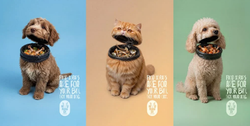
Proudly Second Best - IKEA · DAVID Madrid & INGO Hamburg · 2023

IKEA sells nursery products designed to comfort babies. But the campaign acknowledged the one competitor no piece of furniture can beat: a parent's arms.

Babies ignore an IKEA cot, high chair and stool in favour of being held by their parents. The products lose, deliberately. That does not make them feel worse. It establishes their proper role. IKEA cannot replace parental love, but it can be the useful second-best option when a parent needs somewhere else to put the baby.

Coca-Cola's Spills - DAVID Miami / WPP Open X · 2024 lets Coke lose in a different way. Bottles and cups are knocked aside during embraces. The drink literally gets sacrificed because the reunion matters more. The spilled Coke strengthens rather than weakens the brand's association with human connection.

Don't Wait For Luck to Happen - Dutch State Lottery · TBWA\NEBOKO · 2022 goes further still. A lottery brand admits that some experiences are worth more than winning, following a son who chooses a journey with his father rather than waiting for luck to deliver one.


4. Demote the Icon

Put the ambassador you paid for behind the product.

A Taste Worth More - Stella Artois · GUT Miami · 2024

David Beckham enters a bar. Women approach him.

The expected celebrity-advertising plot is already writing itself.

Except they are not interested in Beckham. They are trying to reach the Stella Artois sitting behind him and politely ask him to move.

Stella uses Beckham's enormous fame as a foil, not a crutch. The person who would normally be the object of desire becomes an obstacle between the customer and the beer. Paying for the icon and then demoting him is precisely what makes the product's status feel exaggerated and funny rather than simply asserted.


5. Concede the Moment

Hand the spotlight to the cultural occasion that is already bigger than you.

Second Best Cup - Grinders Coffee · Showpony · 2025

For most of the year, the cup Grinders wants Australians thinking about contains coffee. During AFL Grand Final weekend, there is a rather more important cup around. So Grinders temporarily called its product the Second Best Cup, conceding first place to the trophy already dominating national attention.

The idea works because the brand does not try to manufacture equivalence with the event. It acknowledges the hierarchy everyone already understands and uses the shared word "cup" to earn a role beside it.


What Makes Embrace Second Place Work

The surface executions differ, but the strategic mechanism is remarkably consistent. The brand deliberately concedes a position advertising would normally fight to own.

Tesco Mobile makes its network secondary to people’s real human network.
Monzo makes the bank secondary to the life it should enable.
Avis concedes category leadership.
IKEA concedes emotional primacy to a parent’s arms.
Coca-Cola lets the product become secondary to the human connection it helps create.
Stella Artois makes its celebrity secondary to the product.
Grinders concedes first place to the cultural moment already commanding attention.

That sacrifice is what separates the tactic from ordinary self-deprecation.


The Question That Could Get You There

What could we deliberately put ahead of ourselves so that coming second makes our argument stronger?

Want Your AI to Think This Way?

These tactics come from the Dumb Thinking Engine, one of a growing library of Thinking Engines built to make your AI more creative. Upload it to ChatGPT, Claude or Gemini and give your AI the campaign logic it needs to explore unexpected territories, reframe briefs, generate stronger ideas and pressure-test the ones worth pursuing.

Subscribe to Big Ideas That Work for free tools and updates.

Join today, and we’ll send you the awesome Reframe Value tool.
Great! Check your inbox and click the link to confirm your subscription.
Error! Please enter a valid email address!