
The promo code is often the least creatively considered part of a campaign. A tiny piece of copy nobody expects much from. But the campaigns in this article saw the code differently. They treated it as a rich creative space. The code became a pledge, a memory test, a loophole, a clue, a gaming shortcut, a physical object, or a journey people had to complete. What mattered was not just the discount. It was what the audience had to type, remember, spot, perform or earn to unlock it. Here are seven tactics from the Discount Engine that put the idea inside the code.
- The Commitment Code
- The Earned Recall Code
- The Sponsorship Loophole Code
- The Discovery Code
- The Platform-Native Code
- The Object Is the Code
- The Journey Code
1. The Commitment Code
Make the code a pledge and the act of typing it is the persuasion.
Promise Codes — Lime, The Or, June 2026, UK
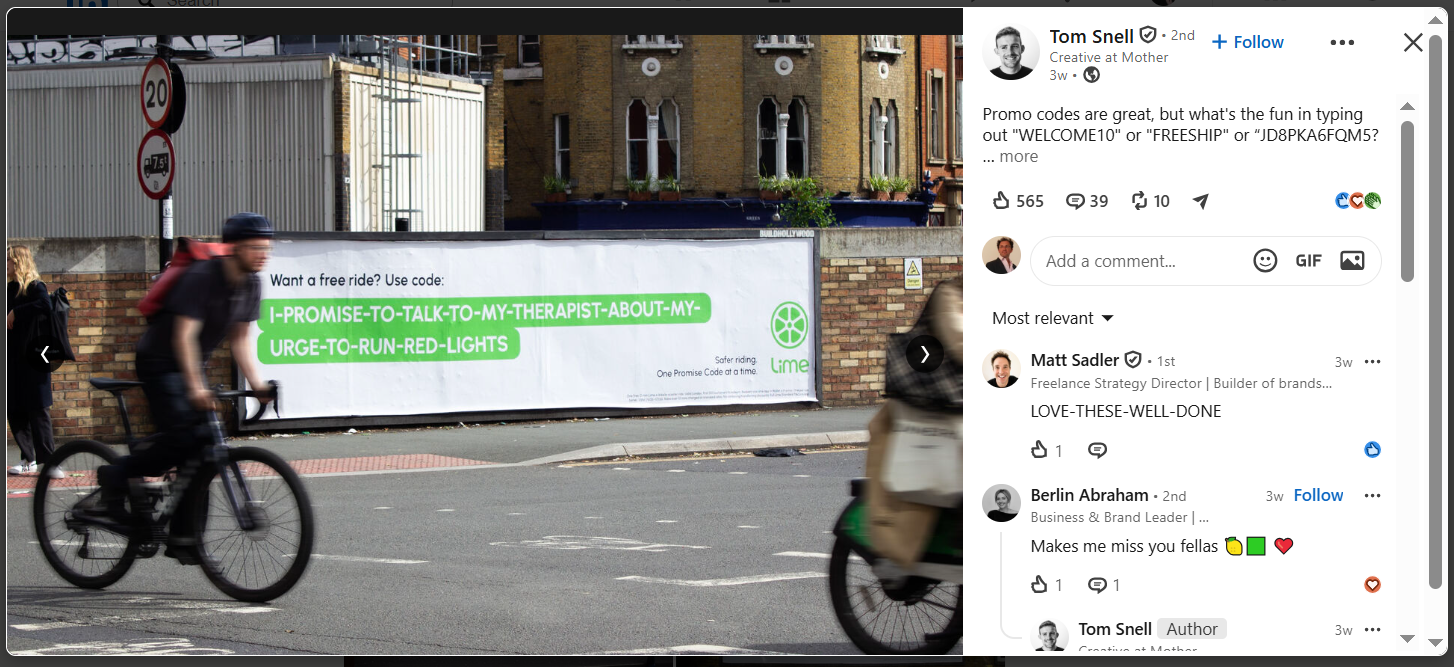
Lime wanted to improve rider safety without lecturing its users. The insight was simple: people are more likely to honour a promise when they have actively written it themselves. So The Or turned the humble promo code into a safety pledge. Riders typed full-sentence promises directly into the Lime app to unlock free riding minutes, with 30+ unique codes appearing across OOH, influencer partnerships and paid social in London, Birmingham and Milton Keynes. The codes read like humorous self-declarations: I-PROMISE-TO-POLITELY-SHARE-THE-ROADS-LIKE-I-SHARE-ASSORTED-PICKY-BITS-IN-THE-PARK. The typing wasn’t a barrier to the discount. It was the behavioural trick the campaign was built around.
BWS / M&C Saatchi, 2024, Australia, turned a mandatory ID check that young shoppers found frustrating into a secret verbal code. They were encouraged to whisper “B W Shhh” at the counter and proactively show ID to claim a $5 discount they felt they’d discovered themselves. Over 8,000 people used it in the first week. Compliance became the reward.
Miller Lite / DDB, 2021, USA, also took the same logic into a URL format. To enter a Super Bowl giveaway, fans had to type a ridiculously long 836-character web address, only active during Michelob Ultra’s rival ad. Printed on the back page of the New York Times, in a medium where it couldn’t be highlighted, copied or pasted, the URL was long enough to burn exactly one calorie: the precise difference between Miller Lite and Michelob Ultra.
2. The Earned Recall Code
Make the code something the audience has to remember in order to gain the reward.
Horror Codes — Uber Eats, Rethink, 2024
Halloween is a $12 billion US spending occasion, but Uber Eats was still better known for restaurant delivery than retail. Rethink’s insight was that most seasonal promo codes are instantly forgettable, while horror fans love proving they know every line. So Uber Eats partnered with four Hollywood studios and turned famous quotes from 10 horror films into discount codes. Each day, a quote appeared with letters missing across OOH, social and digital placements. Fans had to solve the line to unlock 60% off candy. The requirement was the point: it turned a discount into a fan test, and made remembering the code feel like winning. See campaign ->
Cliché Codes, Uber Eats / Special New Zealand, 2023, applied similar logic in a sponsorship context. Uber Eats sponsored the All Blacks, but not the Rugby World Cup, so Special turned predictable post-match rugby phrases into time-sensitive discount codes. The campaign reached nearly half New Zealand’s population and generated 84,510 redemptions.