


Giving something up can often say more than claiming something. A brand can surrender its shelf space, its platform, its customers or even a sale. It can recognise the sacrifices its audience already makes. Or it can make an overlooked human cost suddenly visible and physical.
In each case, sacrifice is not merely the subject of the campaign. It is what gives the idea its meaning, credibility or emotional force. Here are seven ways from the Niche Creative Tactics Engine that brands have turned what is surrendered into the sharpest part of the work.
- The Symbolic Ritual
- The Erased Voice
- The Permission Grant
- The Platform Hand-Off
- The Shelf Sacrifice
- The Customer-Tier Cut
- The Ration and the Relic
1. The Symbolic Ritual
Design a gesture the audience performs — and let the act of giving something up do the persuading.
Black Laundry — Lion New Zealand (All Blacks), Steinlager, DDB, 2019
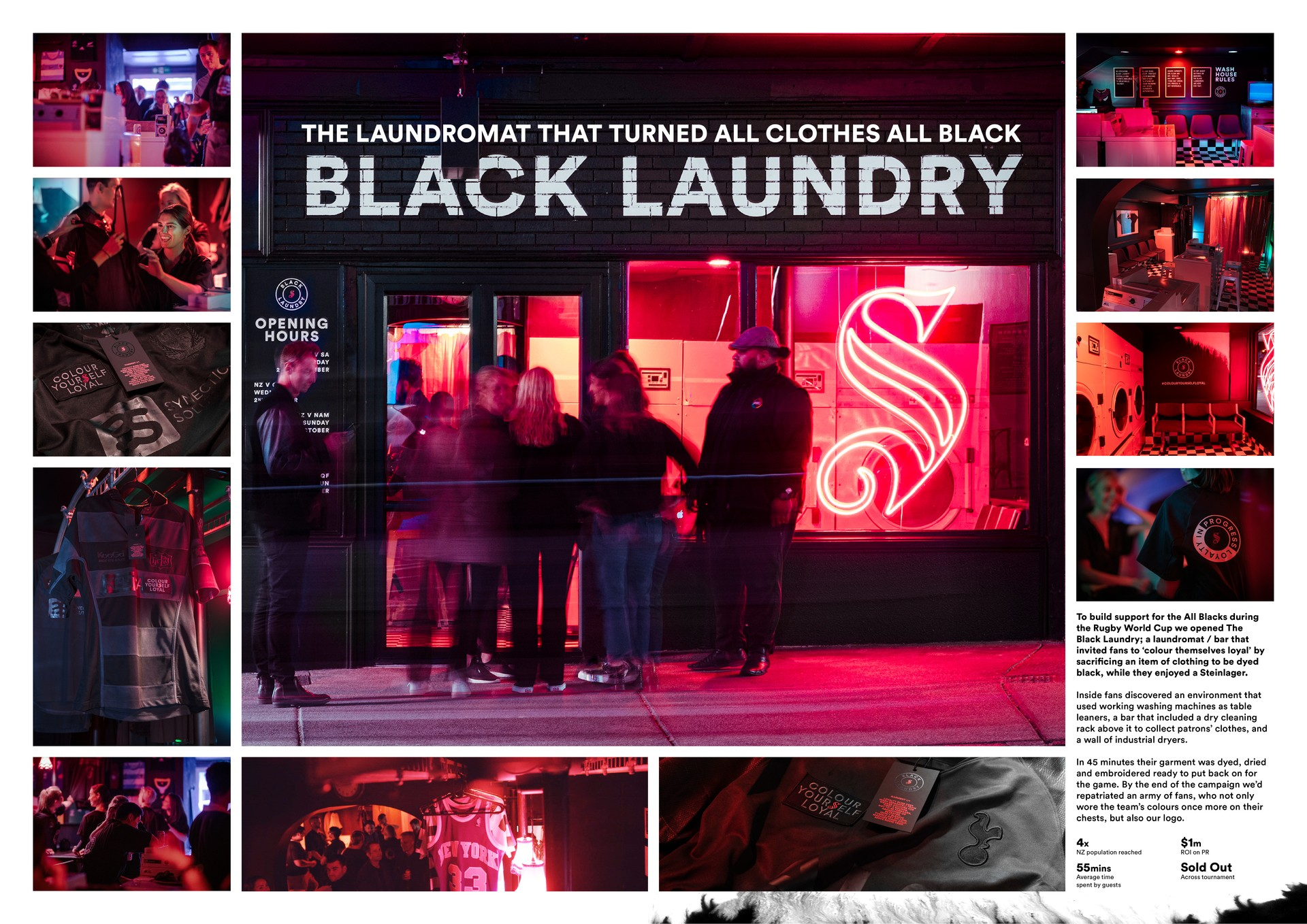
With the Rugby World Cup approaching, Steinlager needed to pull New Zealand rugby fans back from a market increasingly split across other major sports. The Black Laundry was part laundromat, part bar: fans brought in any rival team's jersey and sacrificed it to be dyed black, dried, and embroidered with All Blacks branding — all within 45 minutes, while drinking. Every session sold out in minutes. For fans who couldn't attend, Steinlager ran Black Mail: post your jersey in, receive it back dyed and packaged in custom front-loading-machine boxing. By the end, the campaign had repatriated an army of fans wearing both the team's colours and Steinlager's logo. Reach quadrupled New Zealand's population. $1m in PR value. Average dwell time: 55 minutes in an event built around a washing cycle.
Duolingo's Krispy Fried Duo parodied Japan's KFC Christmas tradition by offering fried owl buckets only to learners who had kept their streak alive. The reward required a prior sacrifice — sustained daily practice — which made the absurd prize feel earned rather than arbitrary. Design the sacrifice and the reward arrives with meaning attached.
2. The Erased Voice
Surface what culture buried — and build the campaign around the act of restoration.
Maria Anna Symphony — LG Electronics, AlmapBBDO, 2021
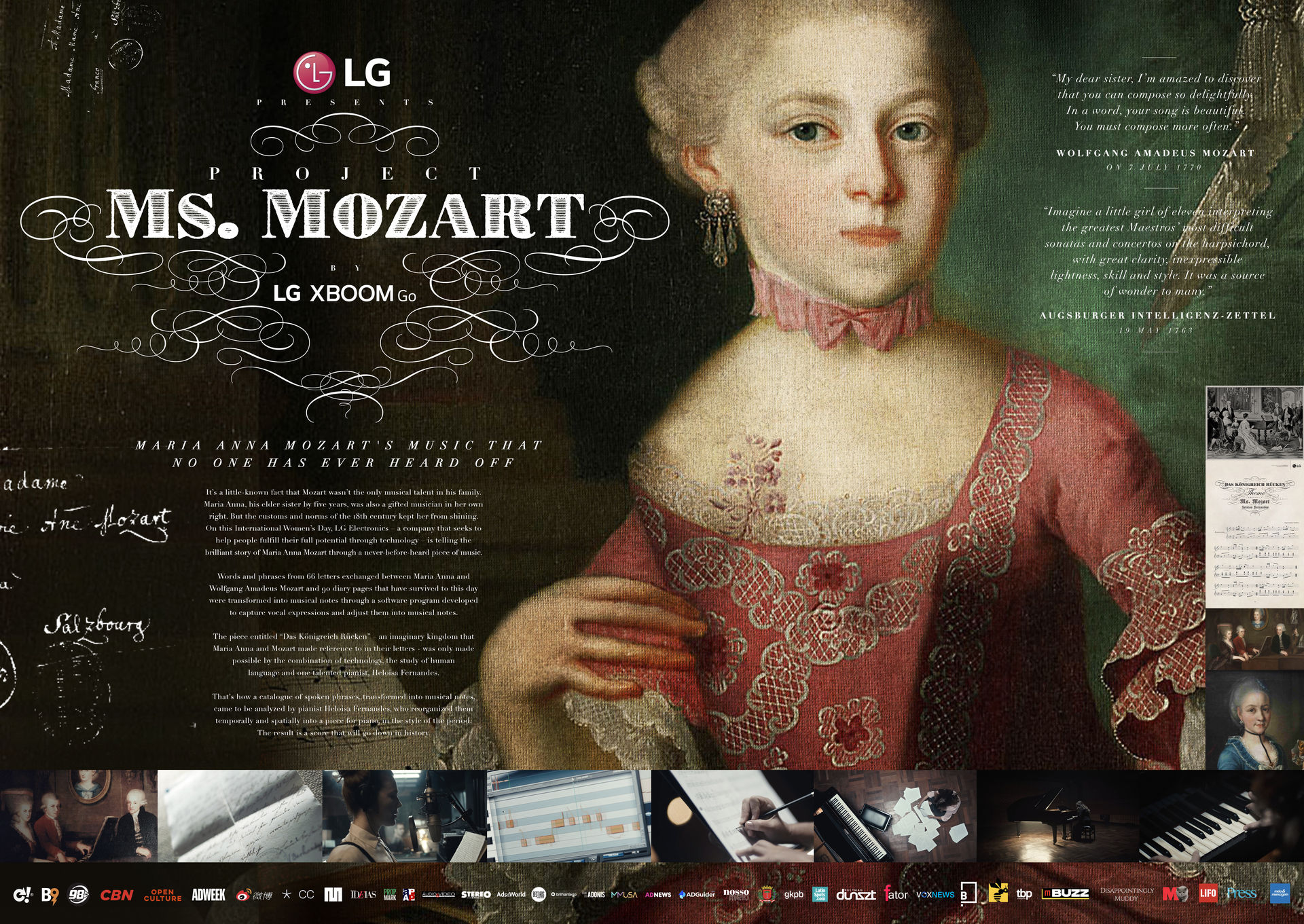
For International Women's Day in Brazil, LG Electronics took Maria Anna Mozart — a composer whose talent was celebrated alongside her brother's until marriage obligations ended her career — and gave her a posthumous premiere. More than 150 pages of her letters and diaries were analysed for individual linguistic and stylistic characteristics, which were used to compose a piece she never got to write: Das Königreich Rücken ("The Kingdom of Back"), named after an imaginary kingdom she and Wolfgang invented in childhood. Pianist Heloísa Fernandes recorded it. LG played it through the XBOOM GO — a speaker built, per the brief, to play any piece at its full potential. The campaign ran on a small social budget with no paid amplification strategy. Fernandes was invited to interview at major Brazilian newspapers and radio stations. Interest in the XBOOM GO rose 15% in the second week of March. The composition is still on Spotify.
Zijkant's The Umbilical Cord (Equal Pay Day) connected champion athletes to their children via umbilical cords in a single image — making the career sacrifice of motherhood visible as a physical constraint on the body of a professional athlete. Prior Equal Pay campaigns argued the case. This one showed the load-bearing structure underneath it.
3. The Permission Grant
Find the sacrifice your audience is already making — and be the brand that tells them it's justified.
It's OK — Oakley, AKQA, 2018
Oakley commissioned Kelton Global to survey 508 athletes on what their sport had actually cost them. The results: 47% had sacrificed friendships, 34% had given up romantic relationships, 91% trained through holidays, 40% would rather excel at sport than at work. These weren't edge cases. They were the mainstream of committed athletic life — and nobody in the category was acknowledging them. It's OK was built directly from those findings. A two-minute film featuring Chloe Kim, Mark Cavendish, Mikaela Shiffrin, Bubba Watson, and Ståle Sandbech showed the athletes facing exactly those costs — missed meals, training through injury, strained relationships, early mornings, failure — with an original soundtrack written for the campaign. The message: in the name of obsession, it's OK. The film reached 40 million views. The song performed well enough that Oakley released it on Spotify. 103 million social interactions. The campaign worked because Oakley didn't ask athletes to sacrifice anything. It just arrived at the moment of sacrifice and said: we see you, and you're not wrong.
4. The Platform Hand-Off
Vacate something the brand occupies — and hand it to someone who couldn't get there otherwise.
LinkedIn Hijack — Sista / UN Women France, BETC Paris, 2023
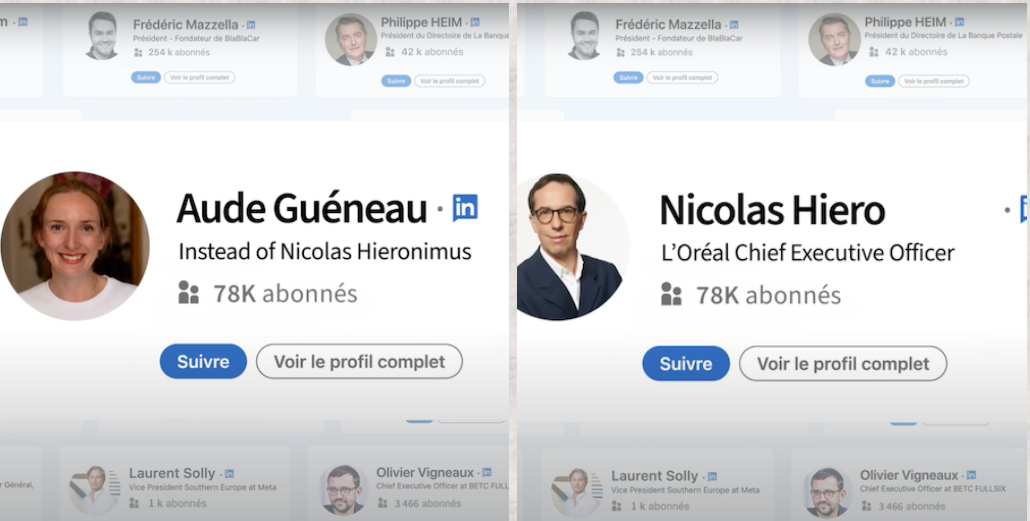
Women in tech are five times less likely to appear in users' LinkedIn feeds. They hold two in ten tech jobs in France and a smaller fraction of funded companies — which reduces visible role models, which reduces the pipeline, which reduces the funding. On International Women's Day 2023, Sista and UN Women France ran 23 simultaneous account takeovers. For 24 hours, 23 male business leaders handed over their LinkedIn profiles entirely — name replaced, profile picture replaced, feed posts replaced — by a French woman working in tech. Among those who gave up their accounts: the CEO of L'Oréal, the VP of Meta Southern Europe, the founding president of BlaBlaCar, the Dean of HEC Paris, the CEO of La Poste Group. And Emmanuel Macron, whose profile was taken over by Chloé Hermary, founder and CEO of Ada Tech School. Each woman posted about her own journey and explained the initiative to an audience the algorithm had been structurally withholding from her. The executives didn't post alongside them. They disappeared for a day and left their reach behind.
Domino's Points for Pies (Crispin Porter Bogusky, 2019) awarded loyalty points to customers who photographed any pizza and scanned it in the app — competitor pizza included. Domino's sacrificed the exclusivity of its own loyalty mechanic. What it bought was an app download, a programme membership, and a brand that looked completely unbothered by whoever made the pizza in the photo.
5. The Shelf Sacrifice
Remove your own product from the space you paid for — and fill it with something that matters more.
Selfless Shelves — Puck, FP7 McCann Dubai, 2024
UN Women reported a 63% increase in unemployed women as a result of Lebanon's economic crisis. Many had turned to making and selling mouneh — handmade preserved foods, an Arab culinary tradition — but had no route to retail. Puck invited these women to package their mouneh in thousands of sanitised, repurposed Puck cream cheese jars, which the women signed. The jars were placed on Puck's own shelf space in supermarkets across Lebanon and sold via e-commerce. Five of the women's stories were made into webisodes. Puck gave up its packaging, its shelf space, and its retail presence to product it didn't make, from women its category had never accommodated. The brand's name was on the jar. The maker's signature was on the label. See campaign ->
Patagonia's Don't Buy This Jacket told its own customers not to purchase the product, flagging the environmental cost of manufacture in a Black Friday ad. The sacrifice was immediate revenue at the year's peak spending moment. What it produced was a brand position competitors couldn't follow without the credibility Patagonia had spent decades earning.
6. The Customer-Tier Cut
Publicly refuse a customer segment — and let the refusal tell your core audience who the brand is actually for.
Choose Uber — Heetch, BETC Paris, 2024
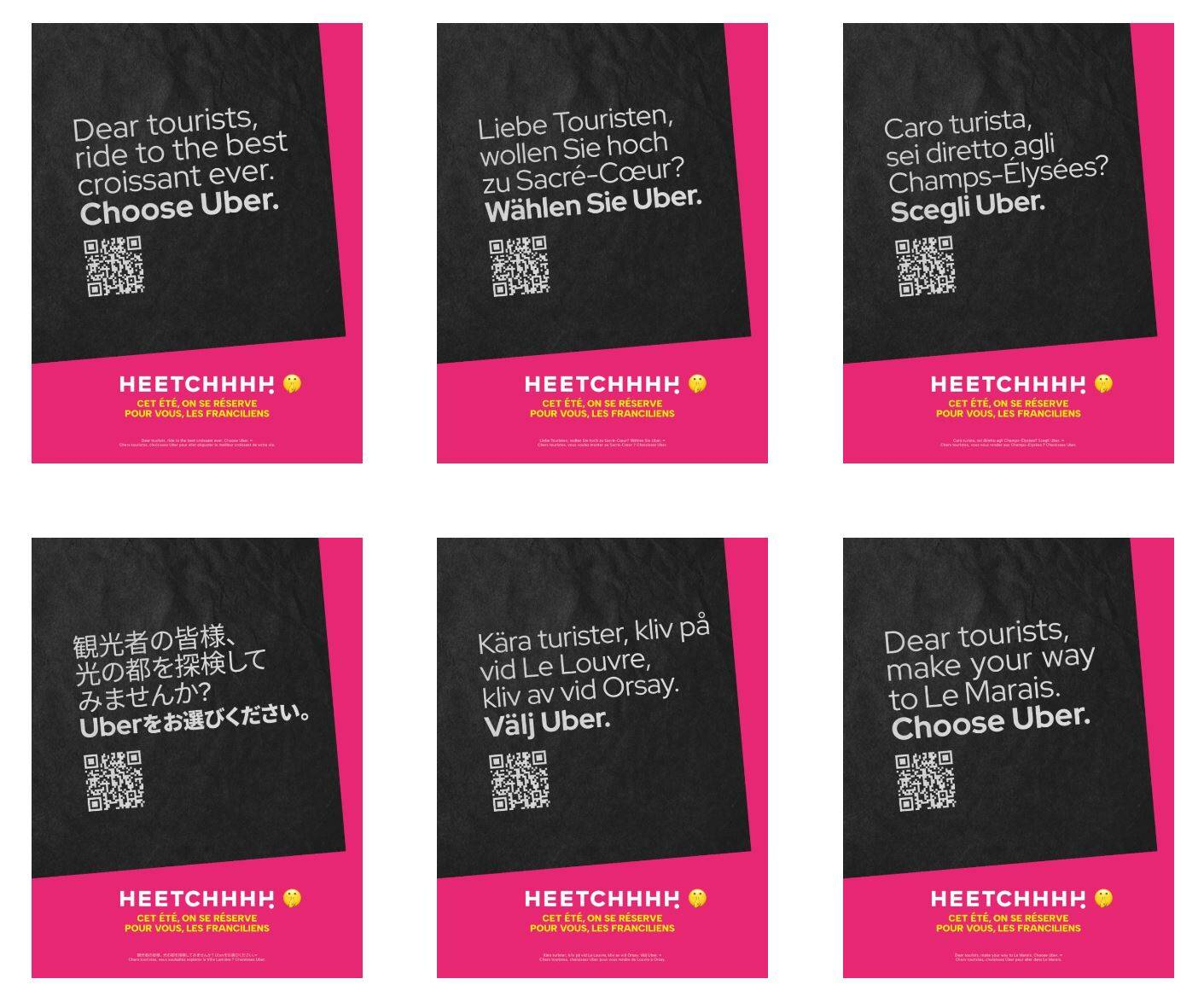
The Paris Olympics brought millions of tourists into a city already in transport crisis: construction delays, overloaded metros, late buses, saturated bike lanes, entire zones closed to vehicles. For Heetch — the locals' ride-hailing app — the influx represented a commercial opportunity worth, by the CMO's own estimate, tens of millions of euros. They passed. Instead, Heetch spent its media budget directing tourists to Uber. The campaign ran in 12 languages across airports, hotels, museums, Olympic venues, baguette wrappers in bakeries, pancake holders, French fry cones, and mobile DOOHs on buses and bicycles circling the city's tourist hotspots. Every communication carried a QR code linking directly to the Uber app download page. Heetch's own drivers were briefed to spread the message. Influencer videos were translated into tourist-facing languages using HeyGen AI. The brand invested its full media budget to give its biggest competitor visibility among the one audience it had decided not to serve — because serving them would have degraded the experience for Parisians, who Heetch described as an absolute priority even before the Olympics made that priority expensive.
7. The Ration and the Relic
Make the cost of someone else's sacrifice physical — so the audience experiences it rather than hears about it.
Orders of Sacrifice — Home Equity Bank / Royal Canadian Legion, Zulu Alpha Kilo, 2021
Remembrance Day donations and awareness had been declining among younger Canadians. COVID-19 had closed the ceremonies that bridged the gap. HomeEquity Bank and the Royal Canadian Legion needed a way to reach a young audience through the one channel they were definitely using: food delivery. On November 10th, historically accurate Second World War ration kits went live on DoorDash in select Canadian neighbourhoods. Each kit — hardtack biscuits, chocolate, tea bags, sardines, evaporated canned milk, canned corned beef — had been assembled in consultation with a Second World War historian to ensure every item was authentic to the battlefront. The kits were priced at $100, marking 100 years of Remembrance Day, with all proceeds going to veterans and their families. The campaign generated 5.4 million media impressions. As part of HomeEquity Bank's wider Remembrance Day activity, the campaign contributed toward $458,000 in individual donations.
The All Blacks' Black Laundry worked on the same principle from the opposite direction — the sacrifice wasn't received, it was performed. In both cases the brand's job was identical: design the encounter with the cost, then get out of the way.
Want Your AI to Think Like This?
These tactics come from the Thinking Engines — a library of strategic and creative guides built to be uploaded into your AI. Drop one into Claude, ChatGPT or Gemini, and it becomes a thinking partner trained on real campaign logic: generating territories, reframing briefs, and pressure-testing ideas.