Fans already carry brands around: on their profiles, on their shirts, in their group chats and on the screens they play on. This tactic makes those places the media, so the message reaches people through someone they follow or trust. The campaigns that do this well give fans something they want, like a nickname, a crate of beer, or a free Whopper, and are open about the brand's role.
- Turn Profiles into Billboards
- Make Fans Walking Ads
- Sponsor a Fan
- Let Friends Do the Selling
- Give Fans the Hijack
1. Turn Profiles into Billboards
Make a personalised asset that fans choose to display on their own profile or post, so their audience sees the brand through them.
The Sopranos Nicknames — HBO, Engine Group, 2019
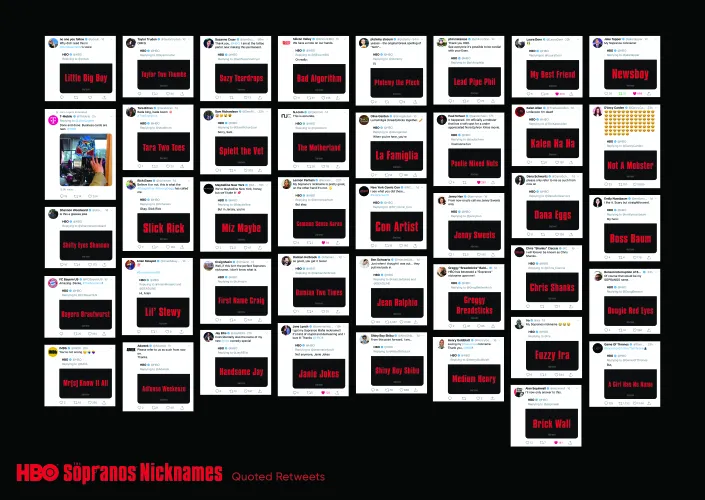
By its 20th anniversary, The Sopranos had been off air for more than a decade, and an anniversary post would have been scrolled past. On 10 January 2019, HBO posted one organic tweet offering a Sopranos nickname to anyone who wanted one. HBO and Engine researched each replier, then wrote and designed their nickname in real time in the style of the show's title card. Roger Federer, Lin-Manuel Miranda and Laura Dern got one, and Jack Dorsey became "Jackie No Edits". Each nickname highlighted something the recipient wanted to show off, and doing so advertised the show to their followers.
The One Show award entry reports more than 24,000 replies to one organic tweet; Marketing Dive reports around 300m impressions, and CBC reports that all of the roughly 200 recipients retweeted their nickname.
Retro Influencers — Skol, GUT São Paulo, 2025
People trust a post from a real drinker more than one from a paid influencer, and paid posts have to be labelled as advertising. GUT searched Instagram for old photos in which people happened to be drinking Skol. A post's image can't be changed, but its caption can, so the owners were asked to add #RetroAd, turning the old post into a disclosed ad. They were paid in beer, more for older posts, and the best were boosted on social and shown on TV and outdoor. Skol's influencers were people who had posted the beer years before anyone paid them.
The creative director's portfolio reports 1,546 participants, a 12% lift in brand consideration and about US$500,000 saved in influencer fees; these are agency-side figures. Gabi Marcatto
2. Make Fans Walking Ads
Put credible enthusiasts out in public, on their bodies or their clothes, as visible spokespeople people can see and question.
Just Ask an Aussie — Cadbury, VCCP London, 2022
Caramilk was so popular in Australia that shops rationed it, but British shoppers had never heard of it and had no reason to believe the hype. About 138,000 Australians lived in the UK. For the 2021 launch, VCCP put real Australian fans on seats built into billboards in Birmingham, Manchester and London, under the line "It's amazing, just ask this Aussie", so passers-by could question them. In 2022, Cadbury sponsored 1,000 Australians living in the UK, paid them in Caramilk and dressed them in T-shirts, totes and hoodies carrying the same line. Anyone curious about the bar could ask someone who had grown up eating it.
The Foamy Haircut — Brahma, Africa São Paulo, 2021
A new Brazilian law banned beer brands from players' shirts, and Brahma sponsored more than 30 teams whose shirts it could no longer use. Brazilian football fans remember players by their haircuts as much as by their shirt numbers. Brahma, which sells itself on smoothness, worked with the barber Ariel Franco on a cut that looks like a glass of Brahma: golden below, white foam on top. Reinaldo of São Paulo FC arrived for a match wearing it, unannounced, and the next day Brahma released a film of him and Franco creating the look. The cut spread to music, TV and Instagram celebrities, and to Chelsea's Thiago Silva and Jorginho as they won the 2021 UEFA Super Cup, and Franco made a tutorial so anyone could copy it. The brand that lost the players' shirts ended up with them on their heads.
WARC reports more than 415m impacts and a 39% rise in Brahma beer sales during the campaign period. — WARC
Tasty Backs — Hellmann's, Ogilvy Argentina, 2026
At a concert, half the photos and videos people take show the stage and the other half show a stranger's back. At Cosquín Rock, Argentina's largest rock festival, Hellmann's invited the tallest people in the crowd to wear T-shirts with a Hellmann's ad printed on the back, in exchange for food. Shorter festival-goers whose view was blocked were rewarded for sharing photos and videos with those backs in them. Every stage photo now had a Hellmann's ad in the foreground.
3. Sponsor a Fan
Sponsor a person whose identity gives them legitimate access to a place or event the brand can't buy its way into.
The HeinzJack — Heinz, FP7 McCann Dubai, 2022
Heinz had no rights to the 2022 World Cup in Qatar, and non-sponsors are shut out of the tournament's official media. Heinz Arabia put out a social call to football fans named Heinz and chose Thomas Heinz from Hamburg, who went to Qatar in exchange for flights and match tickets. For five days, he wore a red Heinz jersey with a QR code to matches, took over Heinz's social channels, and fans who found him could post proof with #FindHeinz to win prizes. Heinz got into the World Cup through a fan who shared its name.
4. Let Friends Do the Selling
Build the ad around a relationship people recognise, so it feels like a friend's recommendation.
Friend-Vertising — Skinny, Colenso BBDO, 2020
Skinny is a low-cost mobile network in New Zealand with about a tenth of its nearest competitor's ad spend, and only 23% of New Zealanders knew it. Its customers loved it, though, and had voted it Consumer NZ's People's Choice in mobile five years running. Colenso BBDO cast 46 real customers and gave each one their own ad, using the same script, sets, and jokes, and asking their friends and family to join them. Each customer stood alone in a two-person scene, on a seesaw or at a chessboard, and outdoor posters went up where the people in them were most likely to be recognised. In a country where everyone seems to know someone who knows someone, a Skinny ad was likely to star someone the viewer knew.
Own Goal No-Nos — Snickers, T&Pm, 2024
Snickers was losing UK market share and wanted a role in Euro 2024 without competing with official sponsors. Football banter happens in friends' group chats, where brands aren't invited. Extending its Own Goals platform, Snickers built an AI version of José Mourinho, trained on his post-match interviews. Fans described a friend's football blunder, and the AI generated a personal Mourinho telling-off, with a human check before each video went out. A partnership with Meta put the tool on WhatsApp, and the real Mourinho teased it during the Champions League final. Snickers got into the group chat because a friend sent it.
5. Give Fans the Hijack
Give fans a tool or a mission that places the brand inside a game, broadcast or event it hasn't paid to be in.
Mission: Whopper — Burger King, DAVID São Paulo, 2022
In-game sponsorship costs a fortune, but Call of Duty players choose their own on-screen names. In December 2022, Burger King Brazil worked with Modern Warfare II streamers such as Coringa to set a mission for squads: rename yourselves after Whopper ingredients and finish a match in the right order on the scoreboard, from Top Bun through Salad, Cheese, Pickle, and Grilled Meat to Lil Bun. Squads that posted a screenshot with #MissionWhopper were sent six free Whoppers. Burger King's burger appeared on the scoreboard of a game it had paid nothing to be in.
Heinzterception — Heinz, Terán TBWA, 2024
Food brands spend heavily on Super Bowl ads, and Heinz Mexico couldn't match them. Many of those rival ads showed food that ketchup would improve. Terán TBWA built an AR filter that recognised rival food ads on the TV and let viewers add a Heinz bottle to the scene, capture it and post it, seeded through influencers and ESPN during the game. Heinz appeared in the Super Bowl's food ads, added by viewers holding up their phones.
The IAB Mixx Mexico entry reports 14m people reached and 43.4m impressions, at 87% lower average spend than competitors. — IAB Mixx
Summary
Each of these campaigns put the message somewhere the brand couldn't have bought space. HBO and Skol used fans' profiles and old posts. Cadbury, Brahma, and Hellmann's used people's bodies, from an Australian on a billboard seat to a haircut and the back of a tall stranger. Heinz sponsored a fan who shared its name; Skinny and Snickers built on friendships; and Burger King and Heinz gave fans a mission and a filter.
When briefing this tactic, start with where fans already show up, then decide what they get for carrying the brand there: a nickname, a crate of beer, six free Whoppers. Skol labelled every post #RetroAd, and Skinny's customers were asking their own friends to join. If fans carry the brand to people paid media can't reach, and keep it because they want to, the tactic works.