

Numan · Execute · August 2026
A white coat can look like healthcare. A prescription can look like treatment. Neither guarantees care. Numan's Cardboard Doctor makes that gap literal: a smiling clinician, convincing from the front, hollow behind it. Providers performing healthcare without its substance become as insubstantial as the cutout representing them
Challenge
The expanding weight-loss market has brought more providers offering access to medication, many using the visual signals of clinical authority. Numan wanted people to look beyond reassuring terminology and smiling doctors, distinguishing real clinical oversight and behavioural support from care that ends at the prescription.
Strategy
Numan avoided attacking weight-loss medication because medication forms part of its own offer. Instead, it isolated the weaker practices that can surround the prescription. Rather than make a direct claim about its own quality, the plan was to let audiences draw the comparison themselves: one model is built to end at the prescription, the other isn't. Positioned this way, the absence of support becomes the rival's defining feature, harder to shake off than being simply outclaimed.
Execution
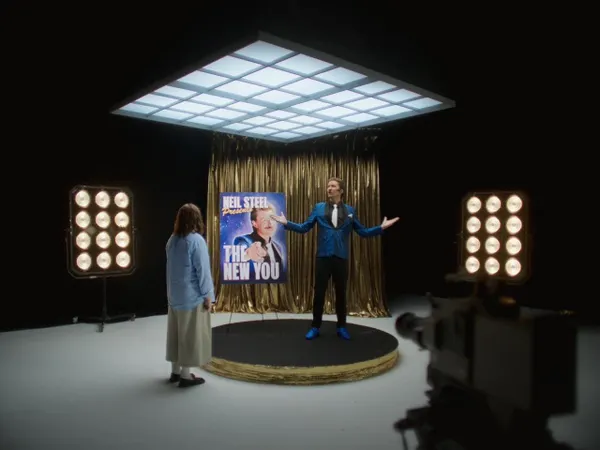
In the first 30-second film, a doctor made from cardboard represents providers that resemble healthcare businesses but offer little regulated clinical support beyond the prescription. Viewed from the front, he looks convincing. From another angle, his lack of substance becomes obvious. His construction and the flaw being critiqued are the same fact told twice, once physically and once clinically. A second film introduces Neil Steel, a fictional conspirituality guru promising a dramatic new you. Numan counters both characters with a grounded proposition: effective treatment combines medication with ongoing clinical care, behavioural support and expert guidance.
Campaigns That Used Similar Tactics
Rival Framing - Letting the audience make the comparison
The Markup Marché — The Ordinary made premium skincare look artificially expensive by placing familiar ingredients beside dramatically marked-up grocery equivalents.
The Sneaker Experiment — Zeeman sold the same inexpensive trainer as both a basic product and a hyped limited edition, exposing how branding theatre rather than product substance could drive the premium.
Deliver Better — Knorr turned cold food, incorrect orders and long waits into evidence against delivery, positioning home cooking as the more satisfying alternative.
Building a metaphor that represents the problem
Lungs — WWF depicted a forest as a pair of human lungs, turning deforestation into visible damage to the organs through which the planet appears to breathe.
The Clog — Daiichi Sankyo clogged Madrid's main "arteries" with giant yellow balls representing cholesterol, recreating the hidden mechanics of a blocked blood vessel at urban scale.
Catch of the Day — Surfrider Foundation packaged beach rubbish like supermarket seafood, confronting people with the unnatural "catch" ocean pollution was producing.
The Question That Could Get You Here
How could Numan make weight-loss providers that look clinically credible but offer little care behind the prescription feel physically hollow?