

Netflix · 2026
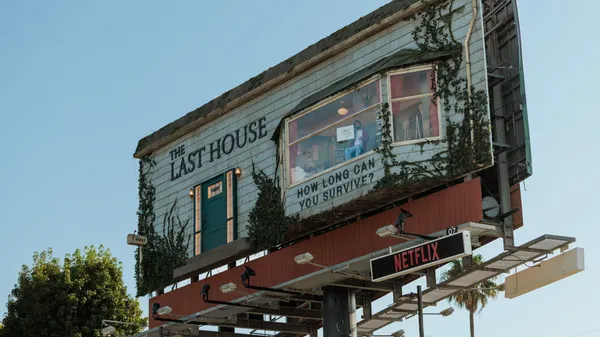
Most film billboards show you the movie's world. Netflix made this one become it. To promote The Last House, a thriller about a family mysteriously sealed inside their home, Netflix built a real furnished room above Sunset Boulevard and put a man inside it.
The challenge
The Last House centres on a family trapped inside their home by an unexplained threat. Netflix wanted to turn that simple, claustrophobic premise into an outdoor idea capable of attracting attention on Sunset Boulevard, where spectacular entertainment advertising is already part of the landscape.
The strategy
Instead of advertising the premise, Netflix recreated its central condition.
If the film is about watching someone trapped inside a house, why put a picture of that house on a billboard?
Put the house there.
And put somebody inside it.
The billboard stopped being a surface carrying the story and became part of the story itself.
People were no longer looking at an advertisement about entrapment.
They were looking up at someone apparently experiencing it.
The execution
For three days, performer Nathan Shoop lived inside a furnished room built roughly 30 feet above Sunset Boulevard.
He ate, read, watched passers-by through binoculars and communicated with people below using a whiteboard. Some returned to check on him and made signs of their own.
Beneath the room was one line:
“How long can you survive?”
The billboard did not explain the film’s premise.
It performed it.
Campaigns That Used Similar Tactics
Make the Medium Perform the Idea: Don't use the medium merely to show the idea. Make its physical properties, placement or behaviour enact it.
Oops — O2 / Havas Media, VCCP, Adcity & Posterscope promoted O2’s free screen replacement by making the advertising itself look as though it had suffered the same accident as a dropped phone. Billboards appeared broken and collapsed, posters were cracked and digital screens glitched or fractured as people passed. Instead of showing a smashed screen, O2 made the medium behave like one.
The Cropped Car — Audi / DDB removed 1.5 metres from car imagery across OOH to represent the legal distance motorists should leave when overtaking cyclists. The missing part of the advertising became the safety gap itself.
Netflix pushes the principle further. The billboard doesn't carry an image of the house. The billboard becomes the house.
Make the Hidden Idea Physical: Turn something normally understood as a phrase, statistic or concept into something people can encounter in the real world.
The Unlevel Playing Field — Puma / BETC Havas São Paulo converted the familiar metaphor of an “unlevel playing field” into a football pitch tilted at 4.5 degrees. Players could physically experience the inequality the phrase normally describes abstractly.
The Clog — Daiichi Sankyo / VML recreated cholesterol build-up by obstructing major arteries in Madrid, turning an invisible medical risk into something people could encounter in the city itself.
Netflix applies the same logic to a fictional premise. “Trapped inside a house” stops being something audiences are told and becomes something happening above the street.
The Question That Could Get You There
What if the advertising had to physically perform the central premise of the story?