



There is a problem with AI and creativity. It isn't that AI is bad at generating ideas. It's that it's too good at generating the same ones.
Ask any AI tool for ten campaign directions, and you'll get ten variations of the same three ideas, dressed differently. Ask again tomorrow, and you'll get them again. This isn't a bug. It's how these models are built. They optimise for correctness. For the most statistically likely answer. For the centre of the distribution. For a lawyer or an accountant, that's a feature. For a creative team, it's a slow death.
Springboards, a Sydney-based AI platform and one of the most established players in AI-driven creative thinking, recently put a number on it. Frontier AI models score an average of 2.88 on the Novelty Bench — meaning that out of ten responses to the same prompt, fewer than three are functionally distinct. The rest are paraphrases. This is clearly a problem for anyone working in the creative industries.
So Springboards built Flint. A new model built from the ground up, tuned specifically for divergence rather than correctness. Lightweight. Fast. Purpose-built for strategists, creatives and marketers who need more starting points and fewer repetitions.
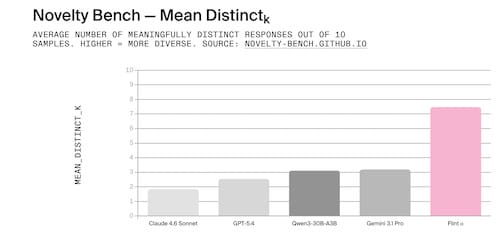
In testing, it scored 7/10 on the Novelty Bench — meaning seven out of ten responses are genuinely distinct rather than surface paraphrases of each other. It's backed by Blackbird Ventures. It's being used by agencies across the US, UK and Australia.
It's all terribly exciting, but it's not the only way to solve the problem. You see, here's the thing about formidable problems. The most impressive defence always assumes the attack is coming from the obvious direction.
At the Mareth Line in Tunisia during WW2, the Germans and Italians were dug into a defensive position designed to stop a conventional attack. What they underestimated was the possibility of being outflanked through the harsh desert and hill country to the west — terrain they considered impassable for a large force. The Long Range Desert Group found a route, and Allied troops used it to flank the position and overrun the Axis forces.
Springboards looked at the AI sameness problem and built the most logical, impressive solution available to a well-resourced team: a new model, tuned from the ground up for divergence. That's the right answer if you're approaching from the front. New model architecture. Latent knowledge entropy. Novelty benchmarking. Three years of R&D. A Sydney office. A New York office. VC backing. Back and shoulder massages on tap. Presumably a very good coffee machine.
Whereas I took a different route. At this point, I should introduce myself. I'm George, the founder of BITW. And the route I took is through the desert.
You see, since 2014, I've been doing something that, from the outside, looks a lot like a cry for help — cataloguing, tagging and categorising thousands of ads for fun. It sort of became an obsession of mine. Splitting metaphor campaigns into sub-metaphors. Sub-metaphors into sub-sub-metaphors. Luckily, AI came along, and I realised my obsession could prove useful.
How?
By creating sets of curated word/PDF documents I've called 'engines' just to make them sound a bit more impressive. No model. No platform. No benchmark score. No Sydney office. Just every creative move that's 'ever been' (ok, slight exaggeration) broken down and organised by strategic intent.
The Engine Guides that power every campaign example on this site don't make AI models less predictable. They give the models a specific creative move they wouldn't make on their own. Or flipped another. They compel AI models to ask better questions derived from reverse-engineering thousands of campaigns.
And that's when it gets interesting.
Because once AI models know the moves and the questions to ask to get them there, they can stack them. Trojan Horse Seduction combined with Dumb Thinking. Salient Anchoring run against a Shift Category frame. The guides aren't just individual tactics — they're a vocabulary. And a richer vocabulary doesn't just produce more outputs. It produces genuinely different ones, pointed in directions a wider model wouldn't naturally travel.
Entropy (Flint's approach) gives you more directions. Directed creative thinking (BITW's approach) compels AI models to give you proven ones.
It seems strange to argue that a PDF content library and a ghost-powered blog can match the intellectual heft that has gone into building Flint, but I am confident it can.
And who am I?
I'm a well-respected content marketing consultant based in the UK. No awards. No cool agency creative accounts. No tattoos. Just an unhealthy obsession with why ads work — 14,000+ campaigns catalogued, categorised, and turned into this.
An outsider, basically. (I've never even set foot in Cannes).
Now imagine yourself, someone who is undoubtedly smarter than me, armed with the same engines and your AI of choice. You'll probably find the spark that kicks off award-winning work before your first coffee goes cold.
And that's all the buzz I need to keep marching through the desert.