
One asterisk can rewrite a national motto. Change one word and a child’s dream becomes a gamble. An idiom about cowardice ends up describing the organ shortage. A cleaning brand cleans people’s names. Wordplay works because the audience does the last bit of thinking, and people hang on to what they’ve worked out for themselves. Here are eight ways to make the language do the work.
- Micro-Edit, Major Consequence
- Colloquial Double Meaning
- Make Both Meanings Physically True
- Taboo-Relief Double Meaning
- Literalised Double Meaning
- Idiom Inversion
- Formula Sabotage
- Demonstrative Copy Anchoring
1. Micro-Edit, Major Consequence
Change one letter, mark or word, so a tiny edit reveals a much bigger truth.
Égalité* — Ville de Paris · BETC Paris · 2026
Many in France may tell you that gender equality has been achieved. The national motto seems to agree. Liberté, Égalité, Fraternité. To challenge that belief, BETC added one character. On International Women's Day, the Eiffel Tower displayed Liberté, Égalité*, Fraternité, and posters across the city printed the small print beside it: around a hundred terms and conditions of being a girl, from lower pay to most of the housework. Advertising uses the asterisk to bury conditions. Paris used it to put them on show, and won Silver for Copywriting at Cannes Lions 2026.
If I Grow Up by Gun Free South Africa (M+C Saatchi Abel, 2026) changes one word of a childhood phrase, "when" to "if", beside portraits of children and the careers they dream of. 4–100+ by LEGO (in-house, 2026) edited the age range on a Classic box for David Attenborough's 100th birthday, with the caption "Updated for you, Sir David." For campaigns where the letter or mark is the whole idea, see Spelling & Punctuation Wordplay.
2. Colloquial Double Meaning
Use an everyday phrase with two meanings, so the line moves between ordinary speech and the product truth.
We Didn't Have the Heart — LiveOnNY · DeVito/Verdi · 2026
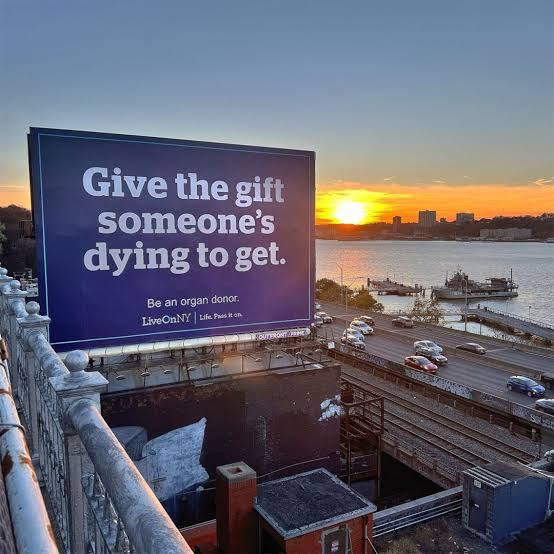
New York has too few registered organ donors and thousands of people waiting for a transplant. Most commuters would rather not think about organ donation on the way to work. DeVito/Verdi wrote twelve copy-led ads for Metro-North, the LIRR and then the subway. One reads "We could have saved them, but we didn't have the heart." Underneath it says "Or the lungs." The phrase people use for losing their nerve becomes a plain account of what is missing. Every ad signs off with "Life. Pass it on."
Chin Up by Ribena (BBH London, 2022) caught people in small awkward moments, such as a botched parallel park, and ended each film with a sip and "Chin up", the phrase for cheering up and the motion of drinking from a carton. For double meanings that only work out loud, see Accent & Pronunciation Wordplay.